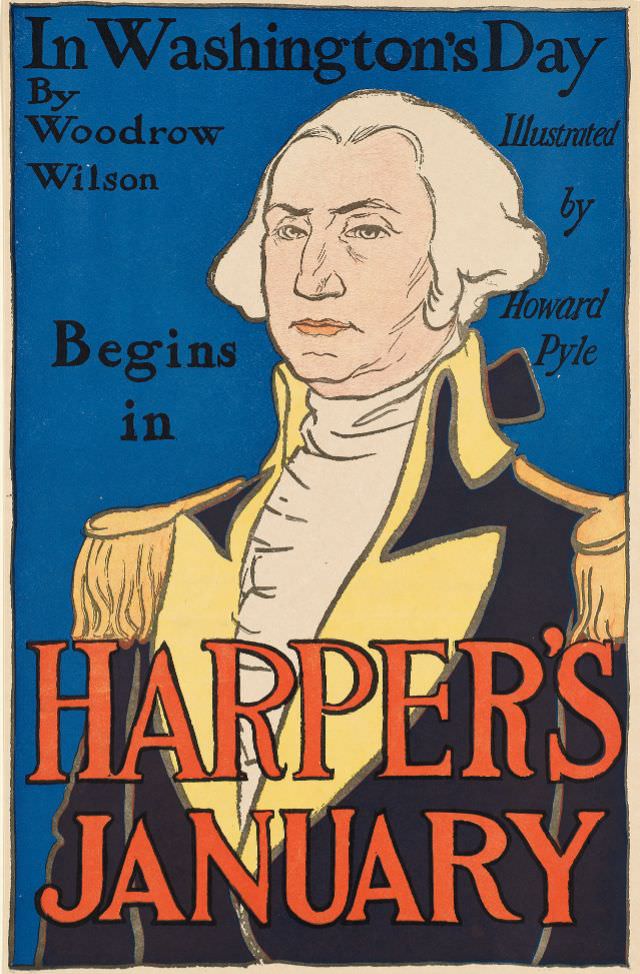
Bold color and confident linework turn George Washington into a commanding presence on the cover of Harper’s January 1896 issue. Set against a deep blue field, his familiar profile—high collar, military coat, and steady gaze—anchors the composition while oversized lettering announces the magazine’s name and month with theatrical flair. The design balances portraiture and typography, making the founding-era figure feel immediate to a late‑19th‑century reader.
In the surrounding text, the cover advertises “In Washington’s Day,” with credit to Woodrow Wilson and illustration by Howard Pyle, tying the artwork to a broader story about memory and national origins. Washington is rendered less as a distant monument than as a watchful symbol, poised above the magazine masthead as if surveying the modern world that claimed him. The limited palette—blue, cream, black, and warm accents—creates a crisp, poster-like impact that would have stood out on a crowded newsstand.
For collectors and researchers interested in Harper’s Magazine cover art, American iconography, and the visual culture of the 1890s, this issue offers a striking example of how print media packaged history for popular audiences. It’s also a useful reference point for anyone exploring shifting representations of George Washington over time, from engraved formality to bold, illustrative modernity. As a digitized historical image, it preserves both the artistry and the marketing language that shaped how readers encountered the past.