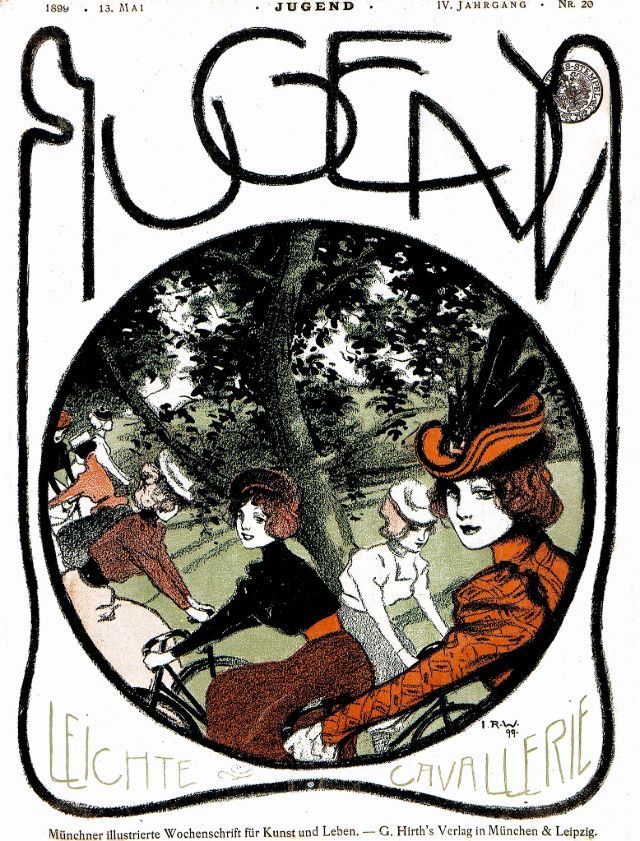
Across the top, the sweeping “JUGEND” lettering frames a lively cover dated 13. Mai 1899, inviting readers into a turn-of-the-century world where illustration and modern life meet. Inside a circular vignette, stylish riders glide along a path beneath dense trees, the scene rendered with confident lines and restrained color accents that feel distinctly fin-de-siècle. The printed phrase “Leichte Cavallerie” anchors the theme with a wink, pairing elegance with speed and motion.
Bicycles take center stage, and with them a sense of urban leisure that was rapidly reshaping European culture at the end of the 19th century. The women’s hats, fitted bodices, and long skirts balance practicality and fashion, suggesting the social negotiation that came with new mobility. Even the background figures and the curve of the road add rhythm, making the ride feel communal—an afternoon pastime turned symbol of modernity.
As cover art, this issue of Jugend works as both advertisement and artwork, reflecting the magazine’s role in showcasing contemporary taste, design, and illustrated storytelling. The composition—bold typography, an emblem-like roundel, and selective color—makes it especially compelling for anyone interested in Art Nouveau graphics, German magazine history, or the visual culture of cycling. It’s an image that still reads clearly today: youthfulness, motion, and a confident stride into a new century.