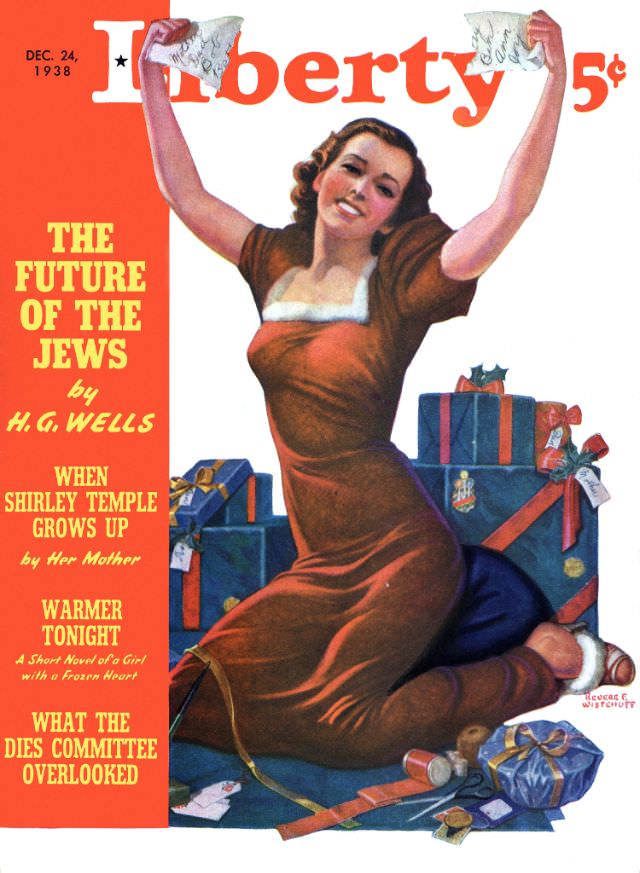
Holiday color and magazine bravado spill across the Liberty cover dated December 24, 1938, where a glamorous woman in a fitted red dress stretches upward with torn wrapping paper in both hands. Around her, blue gift boxes tied with red ribbon stack like props on a stage, while scattered tags, ribbon, and a small spool hint at last-minute preparations. The bright, simplified background pushes the figure forward, letting the illustration’s warm skin tones and saturated reds and blues do the storytelling at a glance.
On the left margin, Liberty’s bold cover lines function like a table of contents in miniature, anchoring the festive scene to the period’s anxieties and curiosities. “The Future of the Jews” by H. G. Wells appears prominently, a stark headline beside the seasonal imagery that reminds modern viewers how entertainment, politics, and world events shared the same newsstand space. Other teasers—about Shirley Temple, a “warmer tonight,” and what a committee “overlooked”—underscore the magazine’s mix of celebrity, fiction, and public affairs.
As cover art, this illustration offers a compact look at late-1930s American visual culture: confident brushwork, an idealized figure, and consumer rituals framed as cheerful spectacle. The five-cent price and the strong Liberty masthead evoke the mass-market reach of weekly magazines, designed to catch the eye from a distance and promise a full reading experience inside. For collectors and historians, the December 24, 1938 Liberty cover stands as both a Christmas-season artifact and a snapshot of what headlines and imagery were considered irresistible on the eve of a new decade.