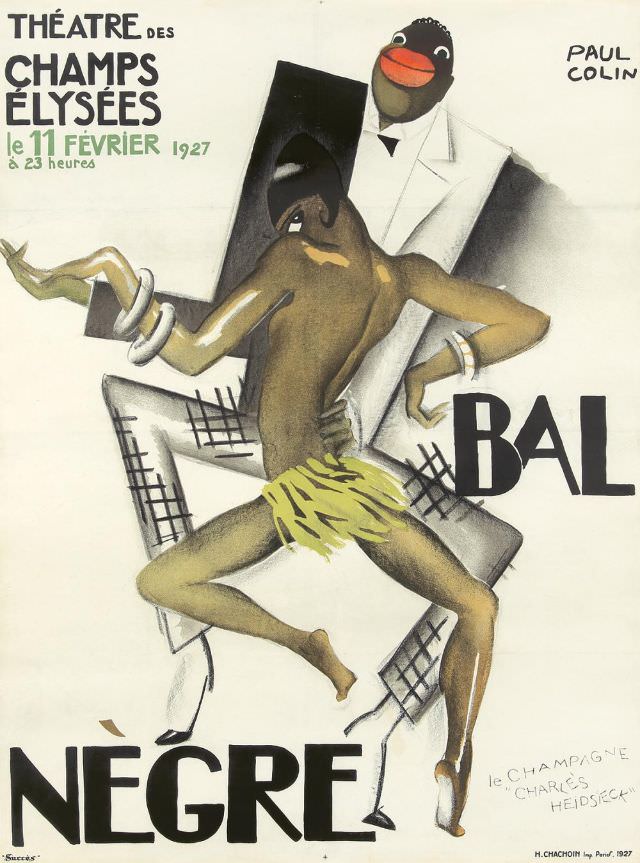
Bold lettering and theatrical flair pull you straight into the world of “Bal Nègre,” a 1927 cover-style poster advertising an evening at the Théâtre des Champs-Élysées. The design leans into the sharp geometry and clean negative space associated with Art Deco graphics, where oversized type and simplified forms do the heavy lifting. French text announces the event details, while the title dominates the lower half to ensure it reads instantly from across a street or lobby.
At the center, a dancing figure is rendered with glossy highlights, stacked bangles, and a raffia-like skirt, posed in a wide, kinetic stride that suggests music and motion even in stillness. Behind, a tuxedoed partner and angular backdrop create a stage-like frame, contrasting dark and light shapes to heighten drama. The palette is minimal but purposeful—black, white, warm skin tones, and bright accents—making the composition feel both playful and strikingly modern for its time.
As a historical artifact, the poster points to the 1920s fascination with nightlife, jazz-age spectacle, and the marketing of exoticized performance for Parisian audiences. Its visual language is inseparable from the era’s entertainment economy, where cabaret, dance, and bold print design intertwined to sell an experience. For readers searching terms like “Bal Nègre 1927,” “Théâtre des Champs-Élysées poster,” or “Art Deco cover art,” this piece offers a vivid entry point into how modernist graphics shaped—and reflected—the cultural currents of the interwar years.