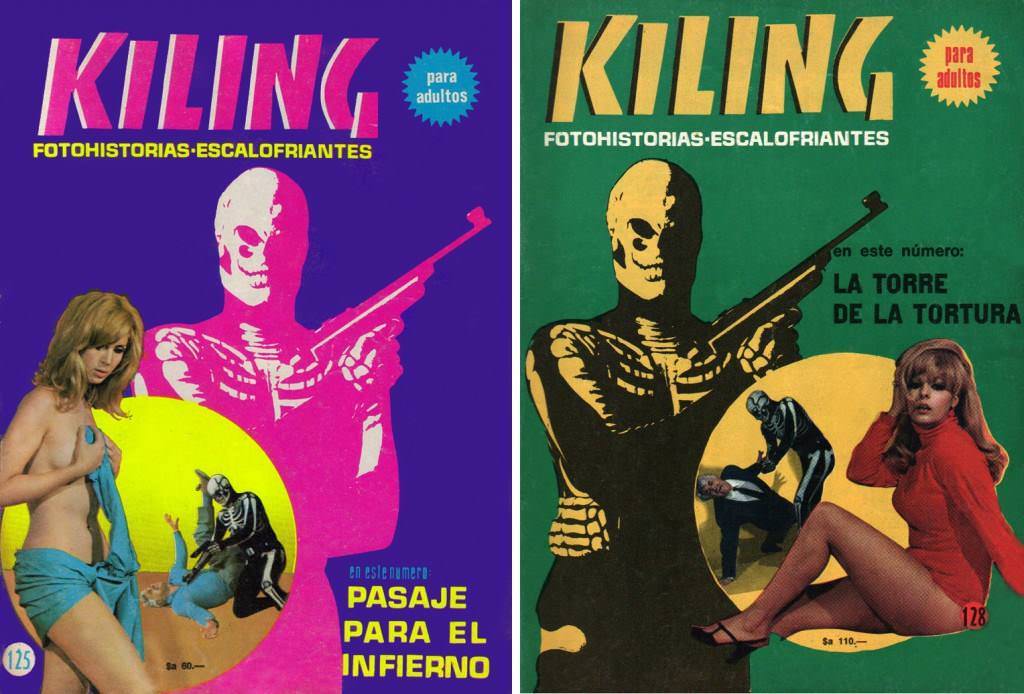
Neon color and pulp menace collide on this pair of “KILING” covers, where the bold headline “FOTOHISTORIAS-ESCALOFRIANTES” promises chilling photo-stories aimed “para adultos.” A skull-faced gunman dominates the composition in high-contrast silhouette, turning the central figure into a graphic emblem of danger rather than a character you can trust. The flat, saturated backgrounds—purple on one cover, green on the other—signal the loud visual language that helped Spanish and Italian crime fotonovelas stand out on crowded newsstands.
Around that stark iconography, the covers stage their sensational hooks: a woman posed in the foreground, a circular inset framing a violent confrontation, and typography that pushes the reader toward the next shock. One issue advertises “PASAJE PARA EL INFIERNO,” while the other teases “LA TORRE DE LA TORTURA,” titles designed to evoke a world of noir excess and cliffhanger cruelty. Even without opening the pages, the layout suggests the fotonovela formula—cinema-like stills arranged to sell speed, suspense, and scandal in a single glance.
For collectors and pop-culture historians, this is cover art that reveals how 1960s–70s crime comics borrowed from film posters, tabloid aesthetics, and comic-book punch to create their own hybrid medium. The mix of staged photography and hard-edged graphic treatment turns melodrama into merchandising, and morality into spectacle. As an artifact of European pulp publishing, these “KILING” covers offer a vivid entry point into the era’s visual storytelling—where crime, desire, and dread were packaged in color loud enough to stop you mid-step.