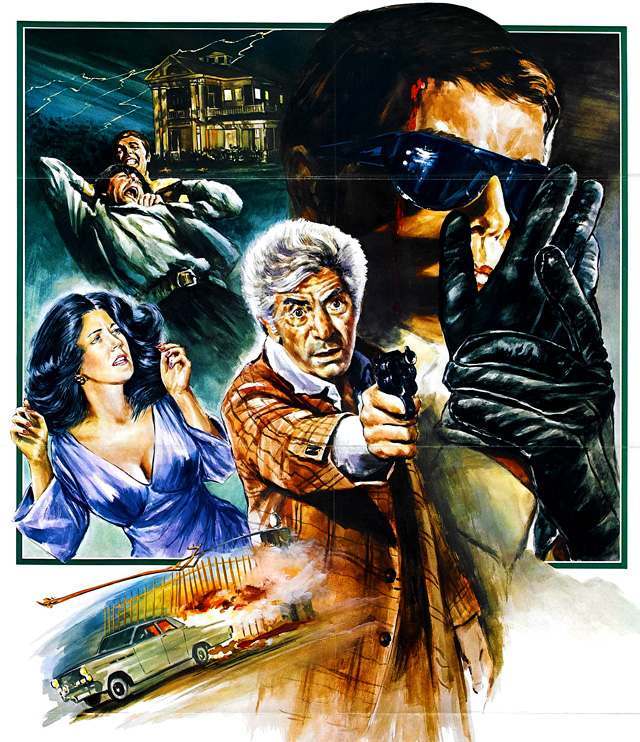
Deathdream (1974) arrives in the form of striking cover art that feels like a fevered collage of fear, duty, and pursuit. Dominating the composition is a hard-edged face hidden behind dark sunglasses and a gloved hand, a visual shorthand for secrecy and menace that anchors the poster’s psychological charge. Around that central figure, the artwork stacks moments of panic and confrontation into a single, breathless narrative.
In the foreground, an older man in a patterned jacket levels a handgun toward the viewer, his expression caught between resolve and dread. Nearby, a frightened woman recoils as if the danger has just turned the corner, while another figure appears mid-struggle, amplifying the sense of helplessness and escalating violence. The painterly style—bold highlights, sharp shadows, and dramatic poses—leans into 1970s genre aesthetics, where thriller and horror marketing aimed to hook audiences at a glance.
Along the lower edge, a car erupts in flames beside a bridge, and in the distance a looming house sits under a stormy sky, tying the chaos to a haunted, domestic backdrop. These elements work like snapshots from a nightmare, suggesting a story that shifts between personal terror and public catastrophe. For collectors and film-history readers, this Deathdream (1974) cover art stands as a vivid example of era-defining poster design, built to sell suspense through pure visual intensity.