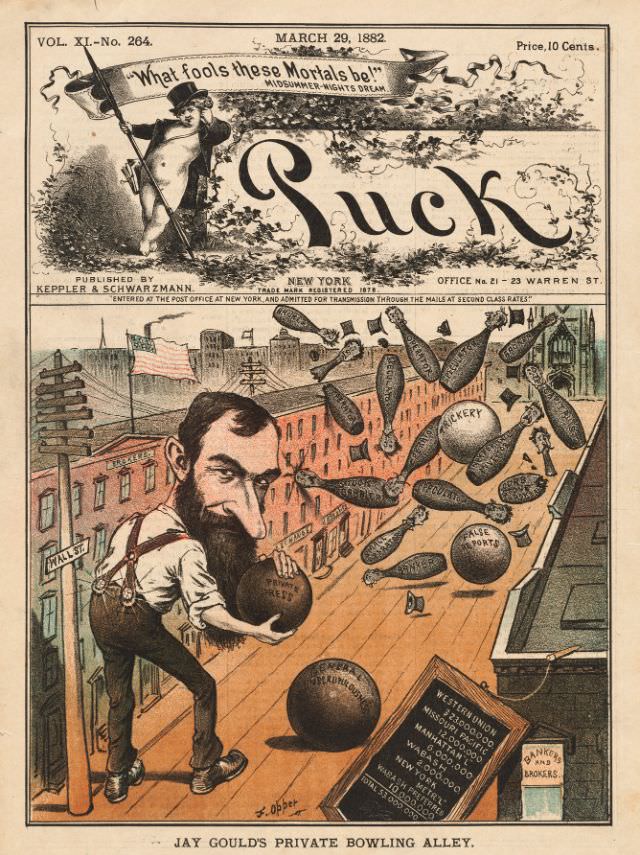
Bold lettering and theatrical flair announce Puck’s March 29, 1882 cover, topped with the Shakespearean tease “What fools these mortals be!” and the familiar masthead that made the magazine a powerhouse of American satire. The page is crowded with period details—publisher information, a New York address line, and the ten-cent price—framing the cover art as both advertisement and editorial statement. Even before the main illustration begins, the design signals a publication that expected readers to recognize politics, theater, and current events in a single glance.
Down below, a caricatured financier is set loose on a rooftop bowling alley, captured mid-throw as oversized balls and pins tumble across a cityscape of brick buildings, telegraph lines, and distant waterfront hints. The caption identifies the scene as “Jay Gould’s Private Bowling Alley,” turning the game into an allegory of power, chance, and manipulation. Pins labeled with suggestive terms and scattered signage—“Wall St.” among them—push the viewer toward a reading rooted in Gilded Age money, speculation, and the uneasy relationship between capital and the public good.
For WordPress readers interested in political cartoons, nineteenth-century magazine covers, or the visual language of American satire, this Puck cover offers a rich snapshot of how humor carried sharp critique. The hand-colored print style and exaggerated physiognomy reflect the era’s approach to mass media persuasion: entertain first, then persuade through symbols. As cover art, it works like a miniature editorial—inviting you to decode its labels, follow the rolling “balls” of influence, and consider what, exactly, was being knocked down in 1882.