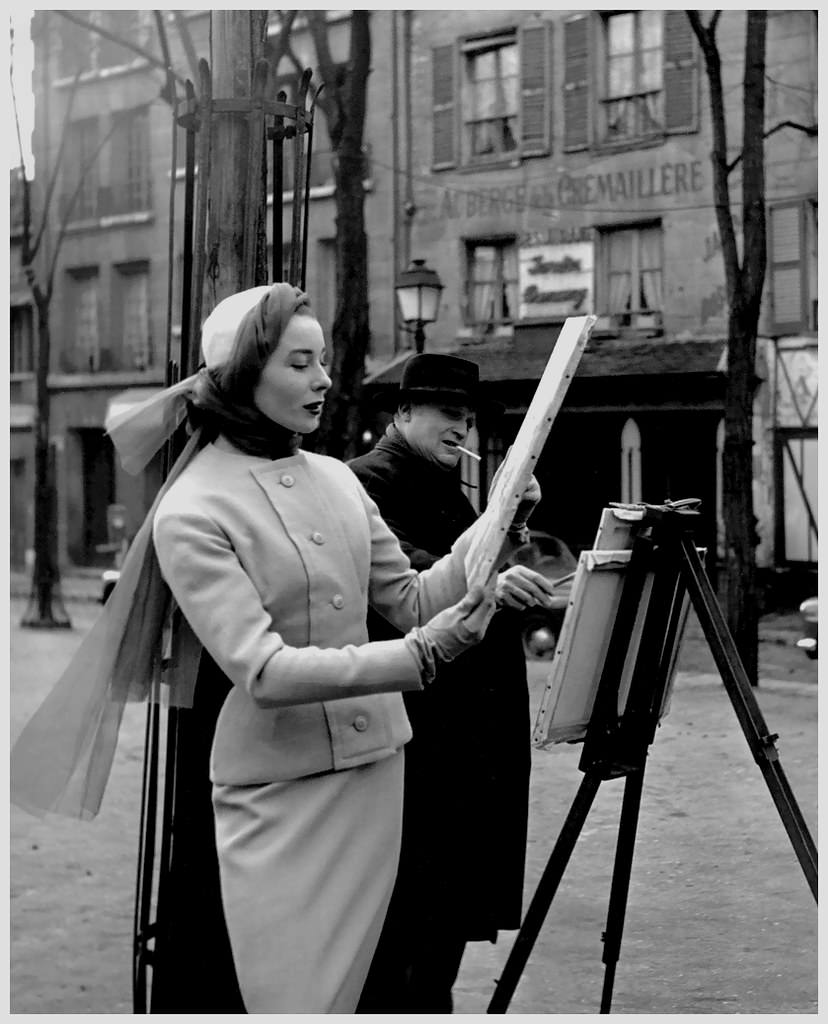
Poised beside a street artist’s easel, Bettina Graziani appears in 1953 with the calm self-assurance that made her an emblem of French fashion. A neatly tailored, double-breasted suit—short jacket over a slim skirt—creates a clean, sculpted silhouette, while gloves and a softly wrapped headscarf add polish and a hint of drama. Her profile, turned toward the drawing board, reads like a lesson in couture-era elegance: controlled, composed, and unmistakably camera-ready.
Behind her, an older man in a dark coat and hat watches with a cigarette at his lips, grounding the scene in everyday city life rather than the sealed world of the studio. Iron railings, bare winter trees, and shuttered windows frame the moment, and a painted sign on the building—partially legible with “…CREMAILLIERE”—suggests cafés and neighborhood businesses just out of focus. The contrast between her refined styling and the informal street setting gives the photograph its spark, as if high fashion has stepped into the public square without losing an ounce of grace.
More than a portrait, the image captures the early supermodel era when couture houses and magazines leaned into narrative: a model not simply posing, but inhabiting a scene. Graziani’s look speaks to postwar optimism and the disciplined glamour of the early 1950s—structured tailoring, immaculate accessories, and the suggestion of Parisian culture in motion. For searches tied to Bettina Graziani 1953, French fashion history, and mid-century street style, this photograph stands as a vivid reminder of how couture and city life could meet in a single, memorable frame.