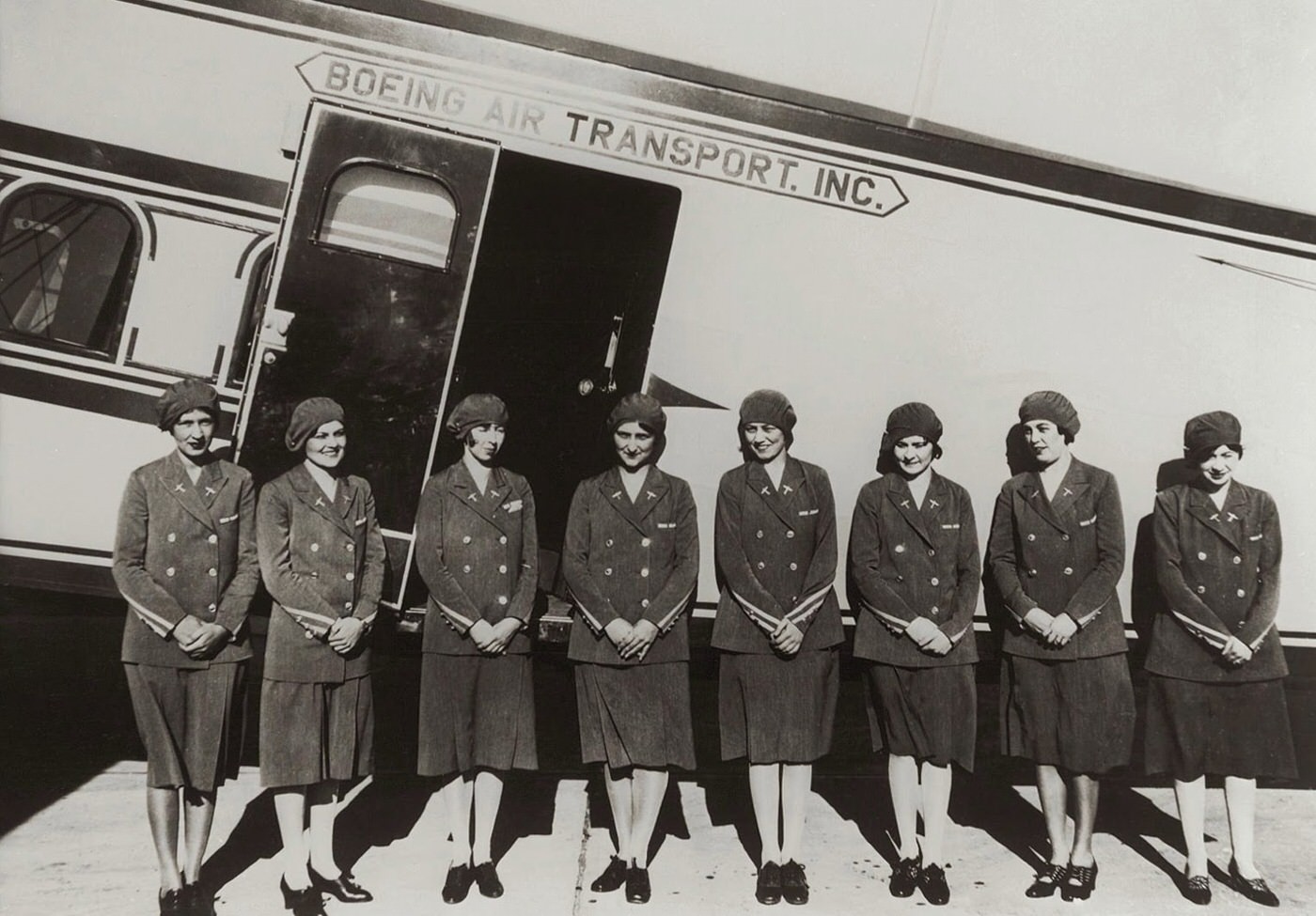
Along the fuselage marked “Boeing Air Transport, Inc.,” a line of early airline stewardesses stands poised for inspection, hands clasped and expressions steady. Their matching double-breasted coats, long skirts, and close-fitting caps read like a uniform of reassurance—designed to signal order and competence at a moment when commercial flying still felt new to many travelers. The aircraft door yawns behind them, a reminder that the romance of aviation was also a workplace with procedures, standards, and expectations.
What makes the scene so compelling is how clearly it links fashion to function in the early airline industry. The crisp tailoring and identical silhouettes suggest discipline and unity, while small details—lapels, buttons, and the neat fall of the hemlines—hint at the careful grooming required of flight attendants from the very start. In 1930, this was a public-facing role built as much on professionalism as on hospitality, and the inspection ritual captured here underscores how airlines cultivated trust through appearance.
As part of a longer story that runs from the Golden Age through mid-century modern style, this photograph offers a valuable starting point for tracing flight attendant fashion and workplace culture across decades. It speaks to the early branding of air travel, when uniforms helped define what passengers could expect onboard and helped normalize the idea of being cared for in the sky. For readers interested in aviation history, Boeing Air Transport, and the origins of the stewardess profession, the image is a striking window into how modern airline service was introduced—one carefully pressed coat at a time.