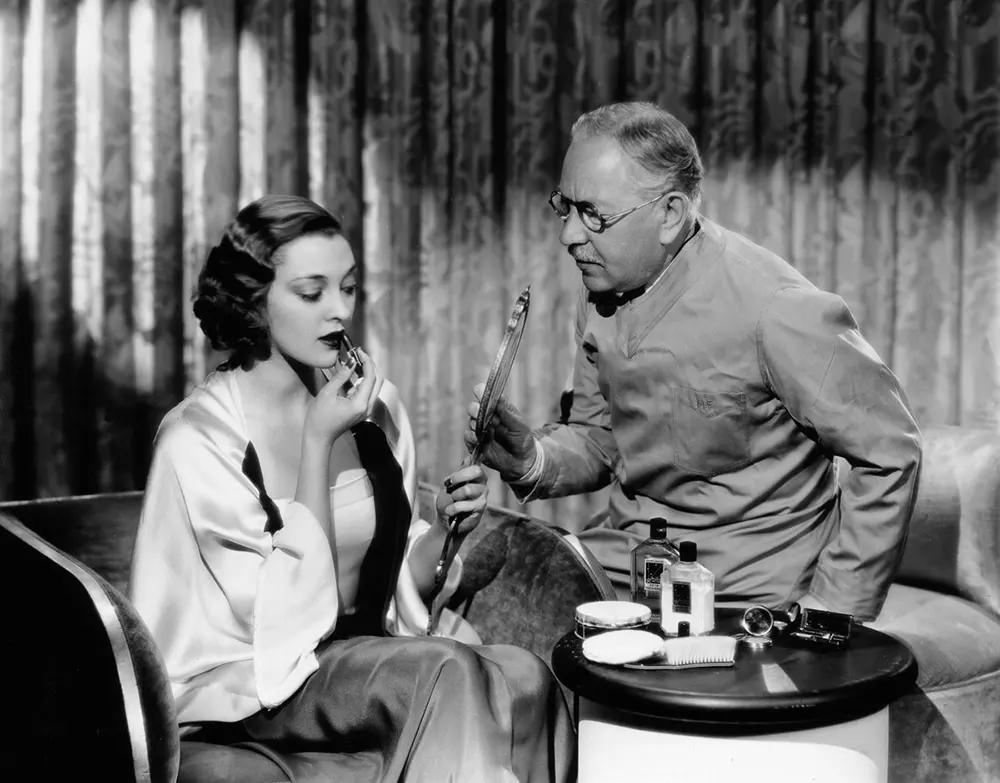
Poised on a sofa in a satin robe, actress Kathleen Burke concentrates on the precise line of her lipstick while an older man in a clinician’s smock leans in to “help” with the process. He holds a long, ruler-like tool toward her face as if makeup were a matter of measurement rather than taste, turning a private beauty ritual into a staged demonstration. The setting—heavy curtains, soft studio lighting, and a small table arranged like a workstation—adds to the theatrical blend of glamour and authority typical of early 1930s publicity imagery.
On the tabletop sit the practical props of the era’s cosmetics culture: bottles, jars, a compact, and grooming tools laid out with near-scientific neatness. The man, identified in the title as Factor, studies Burke’s features with the seriousness of a technician, reinforcing the period’s fascination with expert guidance and “correct” proportions. Burke’s expression remains calm and compliant, a reminder of how film-era beauty standards often framed femininity as something to be refined under professional supervision.
Behind the novelty lies a revealing snapshot of 1930 fashion and culture, when Hollywood-adjacent beauty advice, salon science, and consumer cosmetics converged. Devices billed as calibrators or analyzers promised to detect facial “flaws” and standardize corrections, echoing broader modernist faith in tools, technique, and measurement. As an SEO-friendly historical photo subject, it speaks to vintage makeup history, Max Factor-era styling, and the strange intersection of glamour photography and pseudo-scientific beauty technology in the early twentieth century.