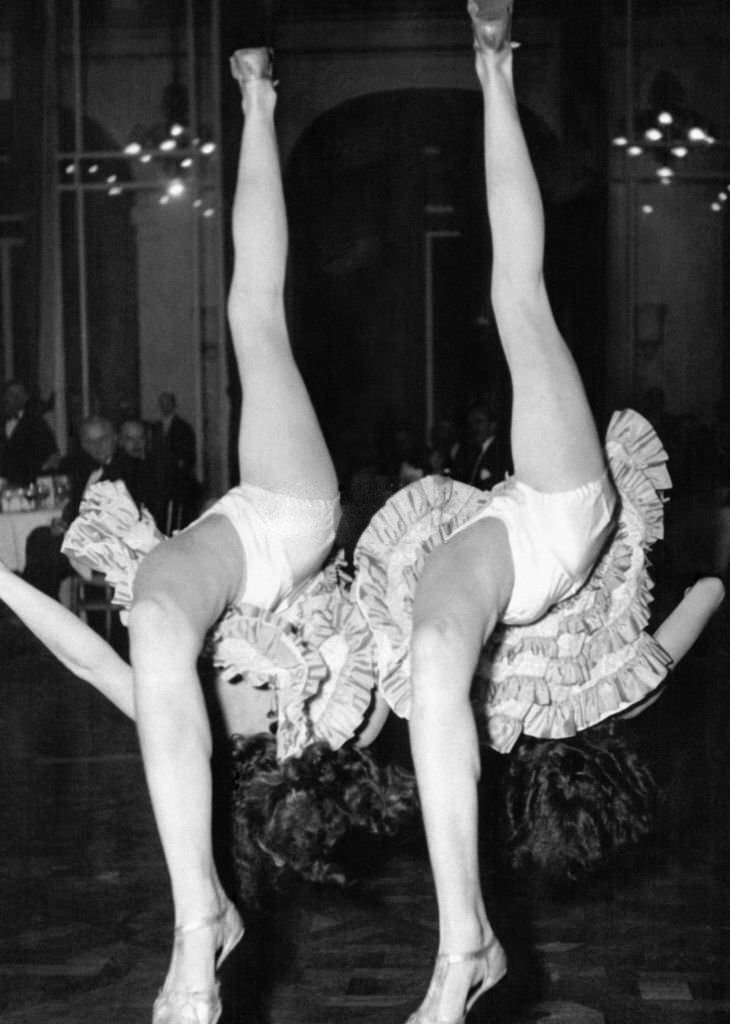
Under the glow of a hotel dining room, two cancan dancers hit a perfectly synchronized high kick, their ruffled skirts flaring as their legs rise into the air with acrobatic precision. Evening-dressed diners sit in the background, half in shadow, watching the spectacle unfold across the polished floor. The contrast between formal tables and daring movement gives the scene its charge: respectable society leaning in to admire a performance built on speed, stamina, and a hint of scandal.
The title places the moment at a dinner offered by the Anglo-American press at the Claridge Hotel in 1906, an era when grand hotels doubled as stages for modern entertainment. Cancan, long associated with Parisian nightlife, had become a fashionable import—lively enough to feel avant-garde, yet popular enough to be booked for elite gatherings. What looks like a single frozen kick is, in reality, the culmination of rigorous technique: balance, flexibility, and showmanship packaged for an audience accustomed to ceremony.
Details in the photograph—the layered petticoats, heeled dance shoes, and the carefully timed symmetry—speak to the cancan’s evolution from rebellious street energy to choreographed cabaret art. Just beyond the performers, the seated crowd and glittering lights hint at the social theater of the early 20th century, when journalism, publicity, and luxury hospitality shaped what counted as “culture.” For historians of fashion and performance, it’s an evocative glimpse of how a high-energy dance could electrify a formal dinner and capture the attention of the press in the Edwardian world.