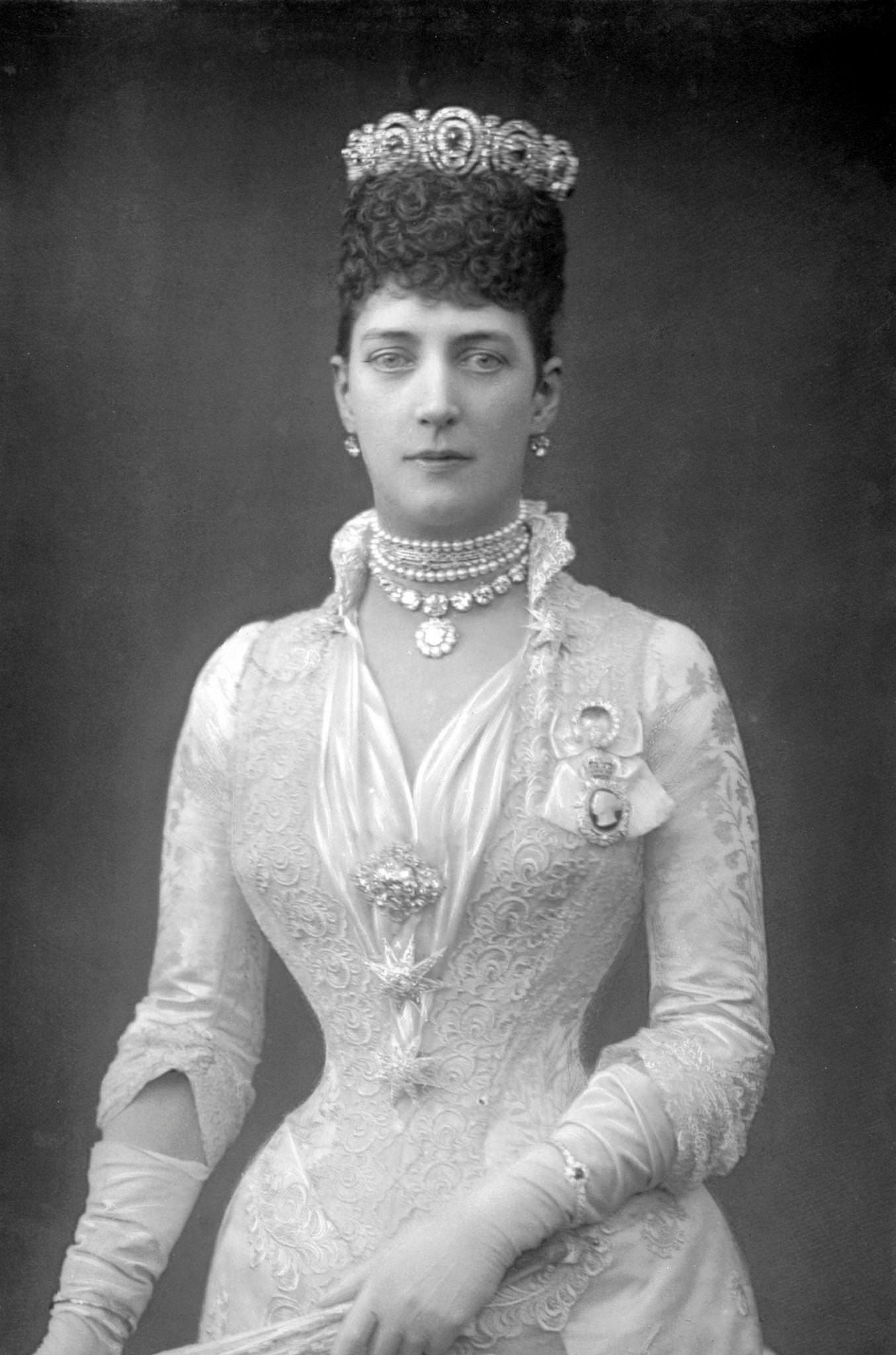
Alexandra, Queen Consort of King Edward VII of Great Britain, appears in this 1890 studio portrait with the composed, formal poise expected of late Victorian royalty. Her gaze is steady and direct, framed by a softly lit backdrop that keeps attention on the sitter rather than the setting. The overall effect is ceremonial yet intimate, a carefully balanced image designed for public memory as much as personal likeness.
Crowned with a jeweled tiara, she wears her hair arranged high in tight, sculpted curls, a striking example of Victorian-era women’s hairstyles that favored height, structure, and meticulous finish. Multiple strands of pearls and a prominent pendant rest at her throat, echoed by sparkling earrings and ornate brooches pinned to the bodice. The gown itself—richly textured with embroidered patterns—pairs an elegant neckline with long gloves, underscoring the era’s ideals of refinement and controlled display.
Fashion and culture meet here in the language of court dress: jewelry communicates rank, textiles signal wealth, and every detail is meant to read clearly even in monochrome. The portrait also serves as a reference point for historians and costume enthusiasts tracing the transition from mid-Victorian restraint toward the more elaborate, image-conscious styles of the fin de siècle. In a single frame, it preserves both the personal branding of a royal figure and the broader aesthetics of 1890s British high society.