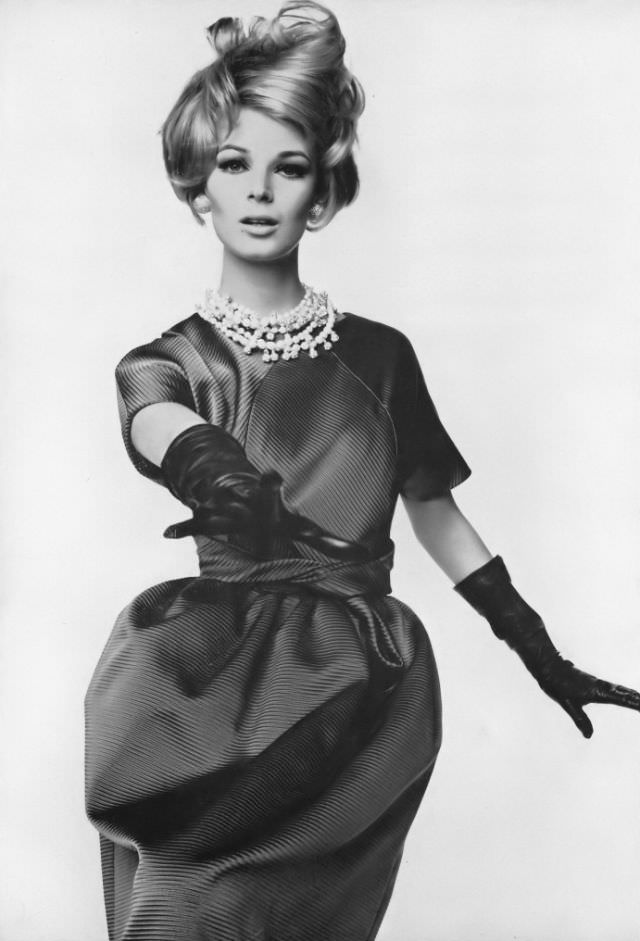
Anne de Zogheb stands poised against a clean studio backdrop, her gaze steady and slightly parted lips lending the portrait a conversational immediacy typical of early-1960s Vogue fashion photography. The silhouette reads as sculptural and deliberate: a deep blue ottoman shell top with rounded seaming that shapes the bodice, paired with a short skirt puffed into a buoyant, architectural volume. Long, dark gloves extend the line of her arms, adding a note of evening drama to an otherwise streamlined, modern look.
Givenchy’s design language comes through in the balance of restraint and spectacle—minimal surface clutter, maximal form. The ribbed ottoman fabric catches the light in subtle bands, emphasizing the garment’s engineered curves and the cinched waist secured by a loopy sash. Movement is suggested rather than shown, as if she has just turned, letting the skirt’s fullness swell outward while the bodice remains crisp and controlled.
Above the neckline, a Richelieu necklace layers luminous strands that brighten the monochrome rendering and frame her face like a collar of light. Verdi’s coiffure rises into a high, airy arrangement, amplifying the era’s fascination with volume and polish while keeping the focus on her features. Published in Vogue on November 15, 1962, the image distills a moment when couture, jewelry, and hair artistry collaborated to create a single, memorable statement of Fashion & Culture.