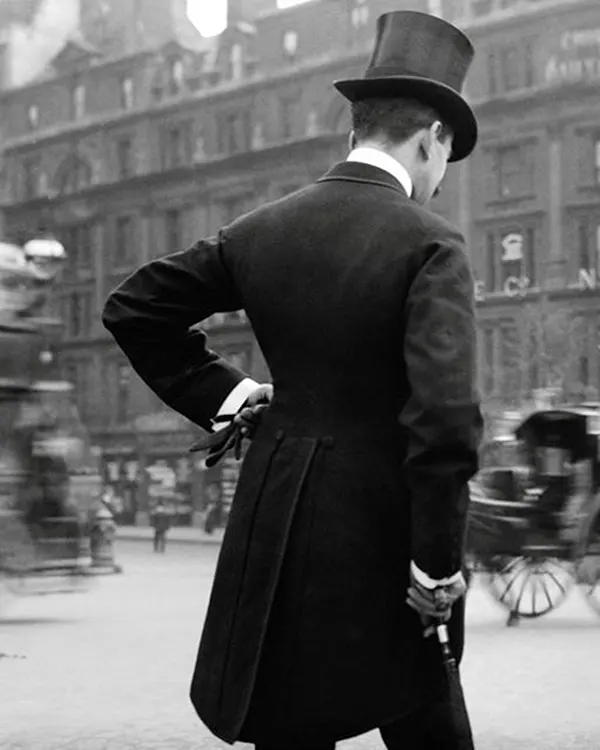
Back turned to the camera, a sharply dressed gentleman dominates the foreground, his top hat rising above the bustle and his long dark coat cut to an immaculate line. One hand rests at his hip while the other holds a cane, suggesting both leisure and authority, the kind of composed posture that Edwardian London prized. Crisp collar and cuffs flash against the tailored fabric, making the silhouette instantly readable as upper-class city style in the early 1900s.
Behind him, London’s street life blurs into motion: horse-drawn traffic and pedestrians pass through the frame, their forms softened by speed, while a large masonry building anchors the background with rows of windows and urban weight. The contrast between the stillness of the man and the rush of the roadway gives the photograph its energy, hinting at a capital in transition—traditional transport sharing space with a modernizing metropolis. It’s a classic London street scene where etiquette, commerce, and movement collide.
Fashion historians often return to images like this because the outfit is less a costume than a social code, written in wool, starch, and polish. The top hat, cane, and fitted coat advertise respectability and rank, yet the clean minimalism of the ensemble still resonates with contemporary menswear—proof that good tailoring ages better than trends. Titled “London, 1904,” the photograph preserves a fleeting moment when style and city rhythm were inseparable, each shaping how Londoners presented themselves in public.