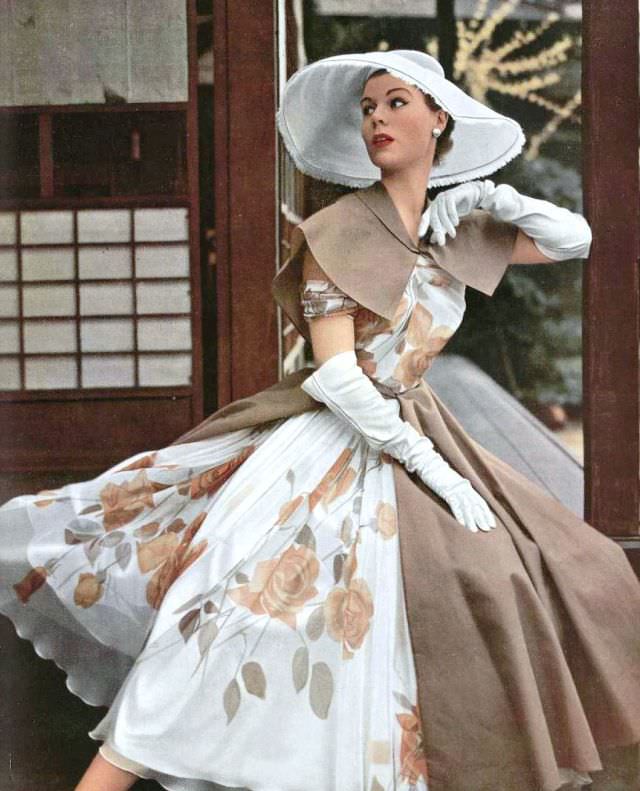
Poised in a sweeping skirt of printed mousseline, “Stella” turns in profile as if caught by a sudden breeze on the way to a garden party. The floral pattern blooms across the light fabric, while a contrasting organdy manteau—sculpted into a cape-like overlay—adds architectural calm to the movement. Long white gloves and a dramatic, wide-brim hat frame her face and posture, sharpening the look into pure 1953 haute couture elegance.
Madame Grès’s signature discipline is felt in the balance between softness and structure: airy textiles, impeccable drape, and a silhouette that reads refined rather than fussy. The bodice sits sleek against the torso, then releases into generous volume, creating that mid-century rhythm of fitted top and swirling hem. Even in color, the palette stays restrained—cream, warm browns, and muted florals—letting cut and craftsmanship lead the eye.
Behind her, the setting suggests a cultivated exterior threshold, with clean-lined panels and garden foliage glimpsed beyond, an apt stage for couture meant to be seen in motion. The photograph works as both fashion history and cultural snapshot, capturing the postwar appetite for ceremony, femininity, and meticulous design. For readers searching Grès 1953, organdy manteau, or garden party couture, this image remains a vivid reminder of why her work is so often called a crown jewel of haute couture.