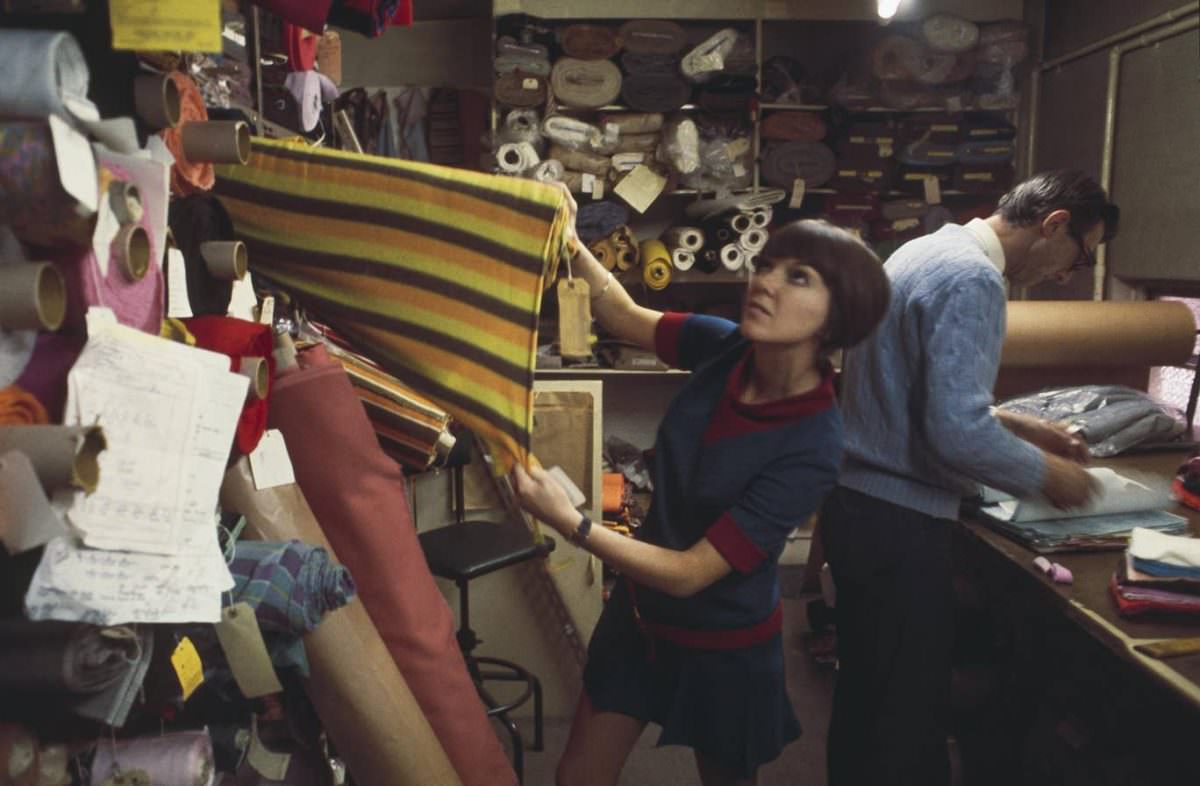
Bright striped fabric unfurls between shelves packed tight with rolls, bolts, and paper tags, turning an ordinary warehouse aisle into a working palette. Mary Quant, dressed in a short, youthful silhouette that echoes the era’s new proportions, lifts the cloth to the light and judges its weight and color in one practiced motion. Around her, pinned notes and stacked textiles suggest the constant churn of ideas that powered London fashion in the late 1960s.
Rather than a runway moment, the scene lingers on the behind-the-scenes labor of design—selection, comparison, and quick decisions made in cramped, utilitarian spaces. The vivid bands of yellow, green, and brown speak to the decade’s appetite for graphic pattern and bold color, while the surrounding neutrals and solids hint at the mix-and-match logic of boutique dressing. A second figure at a work surface reinforces the atmosphere of production, where sketches, samples, and measurements move from concept to cloth.
In 1967, as the mini-skirt and Kings Road style were becoming shorthand for “Swinging London,” images like this help explain how trends were built from materials as much as from myth. Quant’s attention is fixed on possibilities: how a stripe might sit on a hem, how a fabric might drape into a new line, how an affordable textile could be transformed into something modern and desirable. For anyone searching the history of Mary Quant, 1960s fashion, or London’s creative economy, this warehouse snapshot offers a grounded look at innovation in the making.