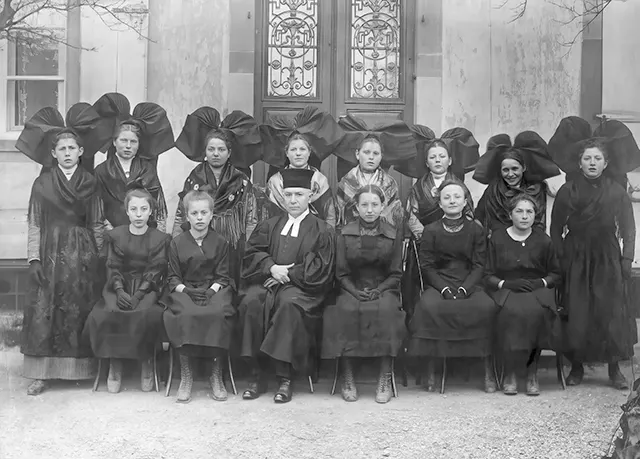
A row of women in traditional Alsatian dress poses with striking Schlupfkapp headpieces, their oversized bows forming a dramatic silhouette against the pale façade behind them. The dark, structured garments and layered skirts read as both everyday practicality and ceremonial pride, while the women’s steady gazes lend the scene a quiet authority. Centered among them sits a figure in formal attire with a clerical-looking collar, suggesting a community gathering where faith, custom, and local society meet.
The Schlupfkapp—instantly recognizable in this historic fashion photograph—does more than decorate; it signals belonging and regional identity in Alsace. Its scale and symmetry turn the headwear into a kind of emblem, amplifying the wearer’s presence in a group portrait and making the collective visual impact unforgettable. Even without a stated date or place, the careful arrangement and the deliberate choice of dress speak to tradition being performed, preserved, and passed on.
Behind the group, wrought-iron door panels and bare branches hint at a formal public setting, perhaps outside a civic building, school, or parish house—spaces where community memory is often staged. The composition reads like a record meant for more than family albums: a documentation of cultural heritage, women’s roles in maintaining it, and the enduring power of regional costume. For readers searching fashion history, Alsatian culture, or the story of the Schlupfkapp, the photograph offers a vivid, human-scale reminder that identity can be worn as well as lived.