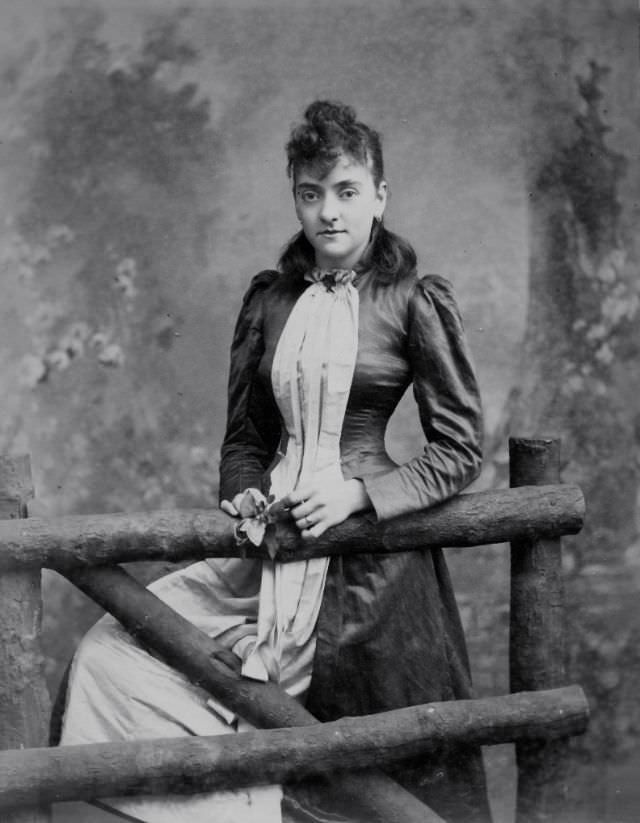
Poised behind a rustic wooden fence, a young Victorian woman meets the viewer’s gaze with calm assurance, framed by a softly painted studio backdrop that hints at trees and garden air. The photographer’s careful staging—half portrait, half pastoral tableau—speaks to late 1800s tastes, when even indoor studios borrowed the language of outdoor leisure and refinement. Her relaxed stance, hands gathered at the rail, balances formality with a suggestion of everyday grace.
Her clothing offers a clear window into Victorian fashion and culture: a fitted bodice that shapes the waist, long sleeves with structured fullness at the shoulder, and a contrasting light panel or scarf-like drape running down the front to brighten the silhouette. Small details do the work of storytelling, from the neat high neckline and bow at the throat to the polished finish of the fabric that catches light in subtle highlights. Even her carefully arranged hairstyle—pulled up with controlled volume—signals the era’s emphasis on grooming, propriety, and social presentation.
Beyond style, the portrait reflects how late 19th-century photography helped define identity, especially for women navigating expectations of respectability and modernity. The fence serves as a visual prop, suggesting a boundary between private self and public image, while the soft-focus background keeps attention on posture, tailoring, and expression. For anyone exploring Victorian ladies, antique fashion, or the social history of the 1800s, this image distills the period’s blend of elegance, restraint, and quiet confidence.