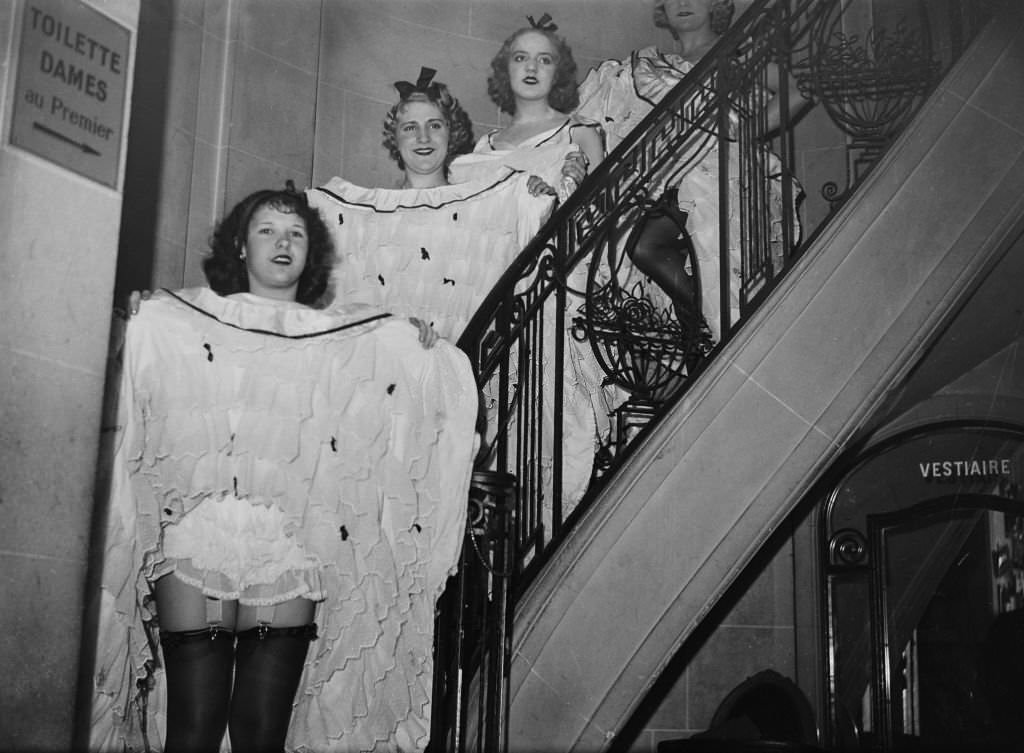
Halfway up a sweeping staircase inside Henry’s restaurant in Paris, a line of French cancan dancers pause and grin for the camera, their ruffled skirts lifted like stage curtains. Dark stockings, bow-tied hair, and bright lipstick sharpen the look of 1930s nightlife, while the performers’ relaxed confidence hints at the athletic showmanship waiting just beyond the frame. The angle emphasizes upward motion, as if the next step will launch them back into the whirl of kicks and spins.
Details around them root the scene in a working entertainment venue rather than a fantasy set: a wall sign pointing toward the ladies’ toilets and a “vestiaire” (cloakroom) entrance visible below. Ornate wrought-iron railings and pale stone walls give the interior a refined, metropolitan feel, the kind of Paris restaurant-cabaret space where dinner, drinks, and spectacle blended into a single evening out. Even in a posed moment, the costumes read as practical performance wear—layered fabric meant to flutter, reveal, and survive repeated, demanding routines.
Dated 1935, the photograph speaks to how the cancan had become both a cultural emblem and a labor-intensive profession, selling Parisian glamour while relying on disciplined bodies backstage. The dancers’ expressions balance charm with composure, suggesting camaraderie and control as much as flirtation. For fashion and culture history, it’s a crisp snapshot of interwar Paris nightlife—where choreography, costume, and architecture all conspired to turn an ordinary stairwell into a prelude to spectacle.