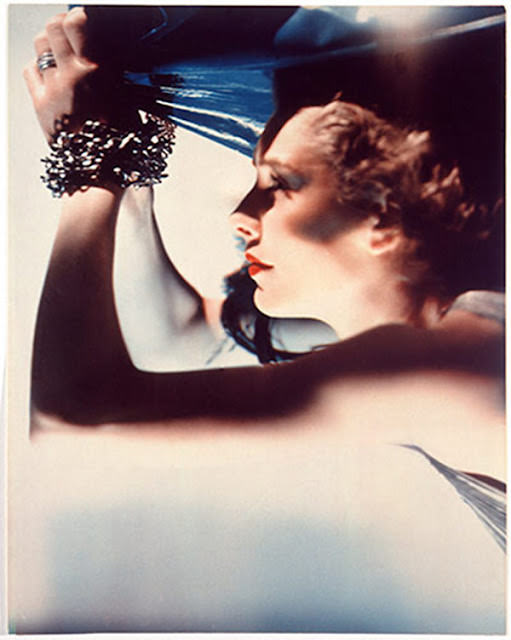
Profiled in luminous color, Mrs Richard Hart-Davis appears as Ariel, her face turned in poised concentration as an arm lifts overhead like a stage gesture caught mid-performance. A deep, translucent blue drapery sweeps above her, casting cool shadows that sharpen her silhouette and heighten the drama of her red lipstick and carefully shaped brows. The close framing and soft focus give the scene a dreamlike hush, as if the sitter is suspended between costume tableau and modern fashion portrait.
Costume details carry much of the storytelling: a sparkling bracelet clusters at the wrist, while a sleek, fitted sleeve contrasts with the airy fabric hovering near her head. Light grazes her cheek and nose in a way that feels theatrical, suggesting studio lamps used not merely to illuminate but to sculpt an otherworldly character. The overall effect aligns with the era’s fascination with mythological figures, turning a society portrait into an imaginative reinvention.
Within the broader context of Madame Yevonde’s celebrated series of “goddesses,” the photograph stands as a vivid example of early color portraiture used for cultural fantasy and self-fashioning in the 1930s. Ariel—associated with magic, wind, and transformation—becomes a fitting persona for a modern woman staged as a classical spirit, both elegant and untouchable. For readers searching historical fashion photography, 1930s color portraits, or Madame Yevonde’s myth-inspired work, this image offers a striking blend of couture styling, cinematic lighting, and theatrical identity.