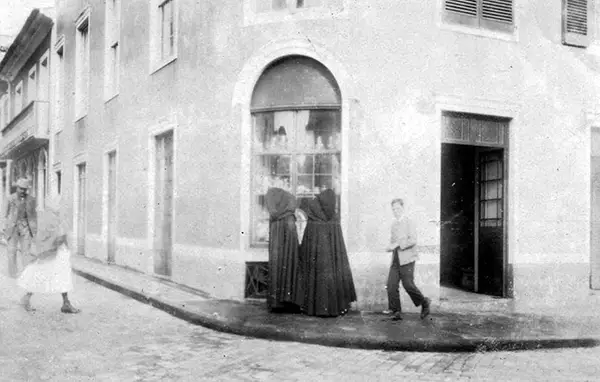
Along a narrow cobbled street, two women stand close to a corner shop window, their tall hooded capes rising like dark silhouettes against a pale plastered façade. The Azorean hood—often seen as a dramatic, sculptural piece of Portuguese traditional dress—draws the eye upward, creating a striking contrast between its sweeping folds and the hard geometry of the arched storefront. A doorway gapes open nearby, and a few passersby blur at the edge of the frame, hinting at everyday movement around an island town’s quiet commerce.
What makes the scene memorable is how fashion and function meet in the same garment: the cape’s generous drape suggests protection from damp wind and sudden showers, while its commanding profile signals custom, modesty, and local identity. The women appear to be conversing or browsing, using the window as a pause point in a shared routine, and the hooded capes become both privacy and presence in public space. In this kind of historical street photography, traditional clothing becomes a language—one that can speak of community norms, social boundaries, and the rhythms of neighborhood life without a single written caption.
Details in the architecture reinforce the sense of place without pinning it to a specific named street: simple upper windows, worn stone at the corner, and the gentle curve of the curb guiding the viewer’s gaze. For anyone searching Portuguese women’s fashion history, Azores culture, or traditional hooded capes, the photo offers a vivid glimpse of how iconic garments were worn beyond staged portraits—on real streets, in ordinary errands, under real weathered walls. The result is an evocative record of Azorean dress and daily life, where a distinctive hood becomes the defining shape of memory.