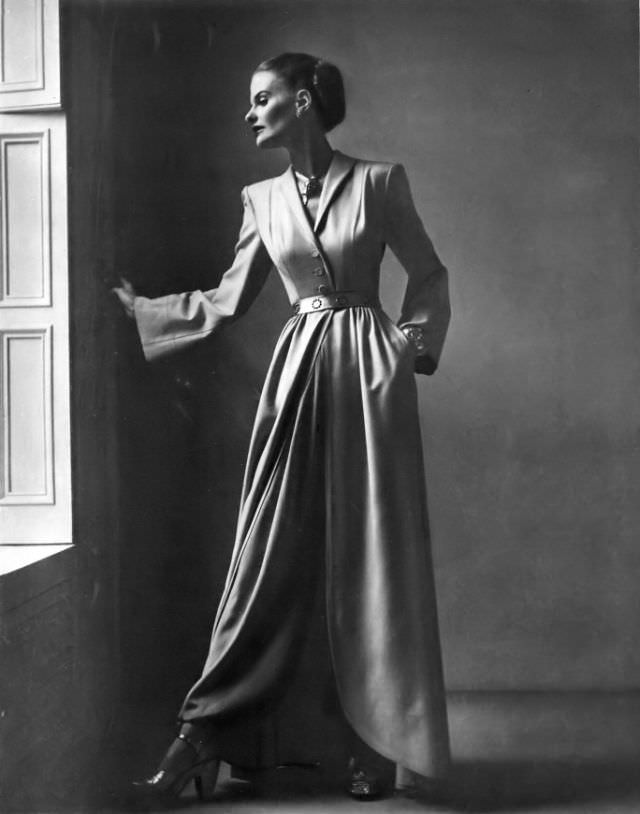
Poised in profile beside a bright window, Dorothy Tivis wears an egg-nog beige wool cut-away hostess coat designed by Joseph Whitehead for Bergdorf Goodman, as styled for Vogue in 1946. The long, fluid skirt falls in generous folds, cinched by a slim belt that emphasizes the new postwar waistline while keeping the look practical for at-home entertaining. Her sleek updo, composed expression, and the subtle gleam of jewelry sharpen the silhouette into something both formal and quietly modern.
Light does most of the storytelling here, skimming across the coat’s structured shoulders and deepening into shadow along the folds to reveal the garment’s weight and drape. One hand reaches toward the wall or window frame, a small gesture that turns a studio corner into an intimate interior, as if the viewer has stepped into a drawing room just before guests arrive. The restrained set—plain wall, geometric window panels, minimal props—lets the couture-like construction and the model’s stance carry the narrative.
Fashion photography from the 1940s often balanced elegance with a renewed appetite for glamour, and this image leans into that moment with clean lines, disciplined tailoring, and an unmistakably editorial mood. The hostess coat, positioned between outerwear and eveningwear, speaks to a mid-century ideal of polished domestic sociability—dressed-up comfort rendered in wool and impeccable cut. As a Vogue fashion plate tied to Bergdorf Goodman’s high-style retail world, it remains a vivid document of American luxury and culture in the immediate postwar years.