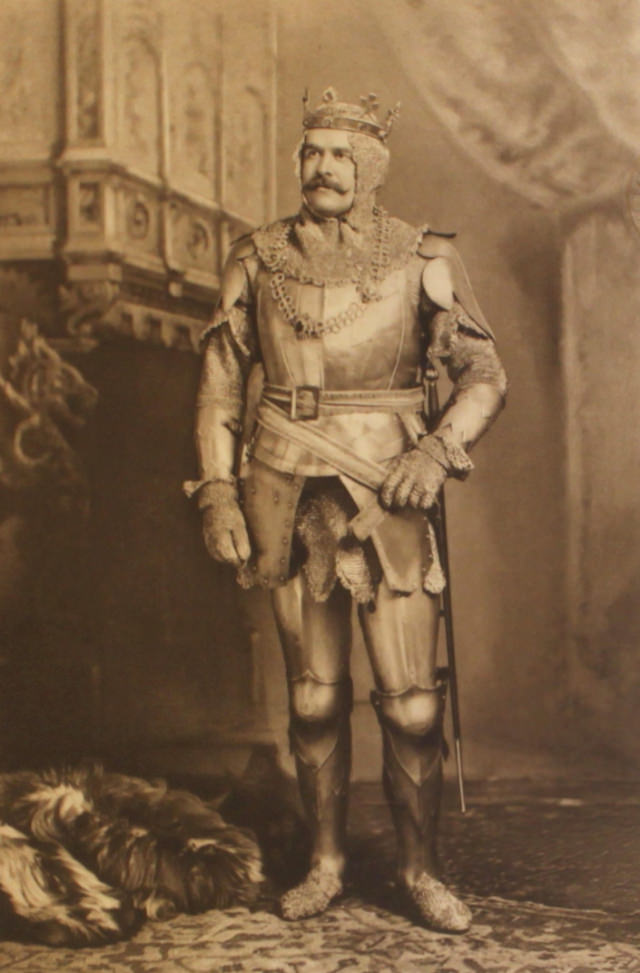
Armored from crown to greaves, the costumed figure stands in a studio-like setting as if stepping out of an illuminated romance and into the late-Victorian world of fancy-dress spectacle. A small coronet sits above a chainmail coif, while a polished breastplate and articulated leg armor catch the light, turning the wearer into a convincing King Arthur for the camera. The hand rests near a sword hilt at his hip, and a heavy chain of office drapes across the chest, lending ceremonial weight to the medieval fantasy.
Victorian high society had a talent for translating literature into lived performance, and Tennyson’s Idylls of the King offered an especially fashionable route into British legend. Here, Arthur is imagined not as a distant myth but as a chivalric ideal—disciplined, commanding, and steeped in pageantry—made tangible through meticulous costume design. The set’s painted architectural backdrop and the richly textured floor covering complete the theatrical illusion, suggesting the photograph was intended as both portrait and proof of participation in an elite cultural event.
Linked to the famed Devonshire House Ball of 1897, the image belongs to a broader visual record of elaborate costumes, aristocratic display, and the era’s hunger for medieval revival. Every detail—the gleaming metalwork, the layered fabrics at the waist, the formal pose—speaks to how legend and literature were used to stage identity, taste, and patriotism at the fin de siècle. For modern viewers searching historical fashion, Victorian costume history, or King Arthur imagery inspired by Tennyson, this portrait preserves the moment when myth was worn like armor.