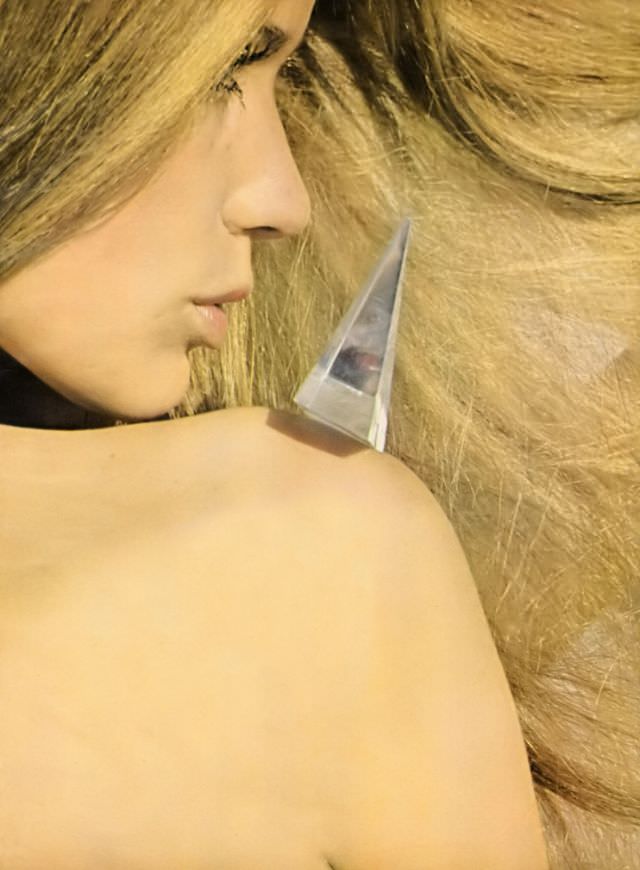
A close-up profile of Veruschka turns the viewer’s attention to quiet drama rather than spectacle: the soft line of her nose, the downcast gaze, and a sweep of pale hair that fills the frame like a golden backdrop. Her bare shoulder is held in crisp focus, creating a stark, modern contrast between skin and the surrounding halo of texture. The composition feels intimate and deliberately cropped, inviting the eye to linger on mood and surface.
Resting against her shoulder is the Lucite ornament by Sant Angelo, a sharply angled, translucent form that catches light like a small prism. Its clean geometry reads as quintessential 1960s fashion experimentation—part jewelry, part sculpture—suggesting a moment when magazines such as Vogue championed futuristic materials and bold, minimalist statements. The ornament’s icy clarity amplifies the photo’s tension between softness and edge, glamour and abstraction.
Published in 1967, the image speaks to a pivotal era in fashion photography when models became muses for a new visual language: cinematic, psychologically charged, and strikingly modern. Veruschka’s enigmatic presence—at once distant and intensely present—pairs with the space-age sensibility of Lucite to encapsulate the decade’s cultural fascination with innovation. For collectors and readers drawn to vintage Vogue editorials, this portrait remains a potent emblem of Fashion & Culture at the height of the Swinging Sixties.