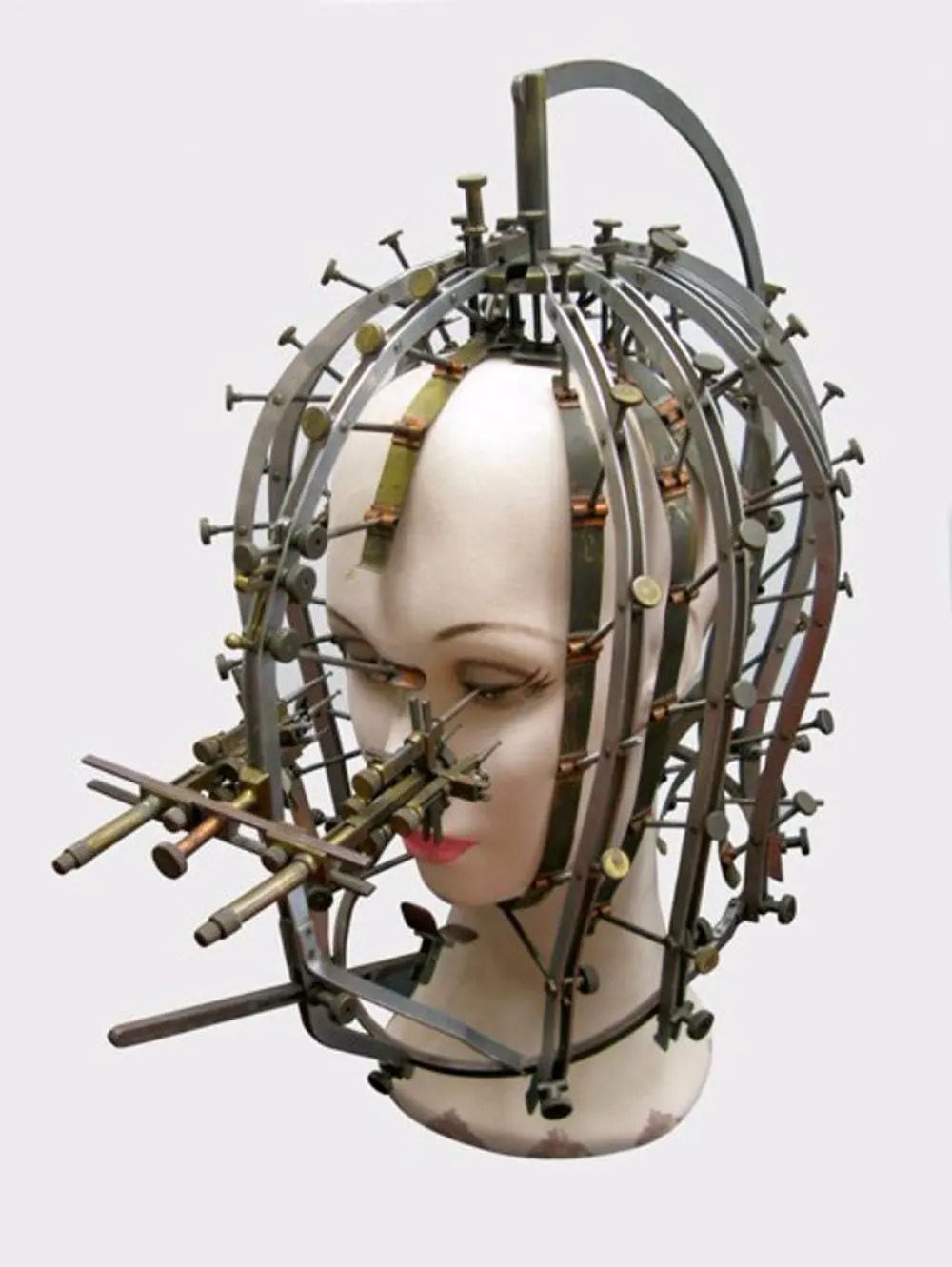
A mannequin head sits imprisoned in a cage of polished metal arcs, pins, and screws—an arresting glimpse of the so‑called “Beauty Calibrator” associated with the 1930s. The contraption wraps around the skull like a mechanical halo, with adjustable rods protruding toward the nose, cheeks, and jawline. Against the stark background, the device’s cold geometry is made even more unsettling by the mannequin’s painted lips and calm, fixed gaze.
Seen up close, the calibrator resembles a machinist’s measuring rig more than a salon tool, built to quantify the face as if it were an engineering problem. Multiple knobs and sliding brackets suggest that each point could be tuned to compare symmetry, angles, and proportions, turning personal appearance into a set of readouts and “corrections.” The design reflects an era fascinated by scientific-looking instruments, where modernity and metalwork promised authority—even in matters as subjective as beauty.
Yet the photo also reads as cultural critique in miniature: fashion and beauty standards translated into hardware, precision, and pressure. The Beauty Calibrator embodies the tension between self-improvement and surveillance, hinting at how anxieties about “flaws” were encouraged and monetized. As an artifact of vintage beauty technology, it remains a haunting symbol of the drive to standardize faces—and of the strange machines built to enforce an ideal.