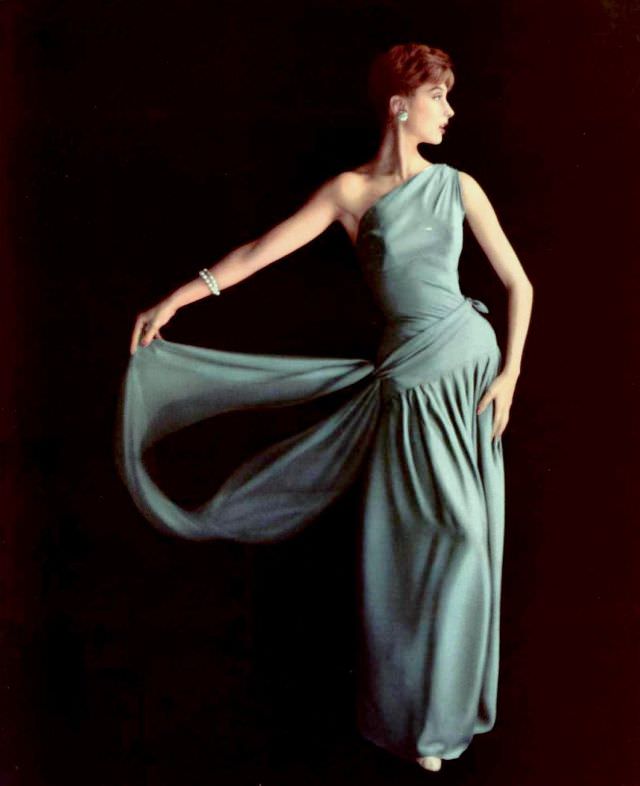
Marie-Hélène Arnaud stands in profile against a deep, unbroken backdrop, her posture poised like a dancer pausing mid-step. The one-shoulder evening gown falls in a long, fluid column, its soft crepe catching light in gentle gradients rather than sharp sparkle. A single arm extends outward to lift a trailing panel of fabric, turning the dress into a moving silhouette even in stillness.
At the heart of the image is the unmistakable language of Grès: sculptural drape, disciplined simplicity, and a devotion to line that feels almost architectural. The asymmetrical neckline frames the collarbone and shoulder with restraint, while the gathered folds at the hip suggest the couturier’s hand shaping cloth into form. Minimal jewelry—small earrings and a bracelet—lets the gown’s construction remain the true ornament, underscoring haute couture’s quiet confidence.
Fashion photography of the mid-1950s often balanced glamour with modern elegance, and this portrait leans decisively toward refinement over spectacle. The dark background isolates the figure, making the color and texture of the crepe de chatillon read as the main narrative, a study in draping and movement. For anyone searching the legacy of Madame Grès, 1950s couture, or the history of the one-shoulder evening dress, this image offers a clear reminder of why her work was celebrated as a crown jewel of haute couture.