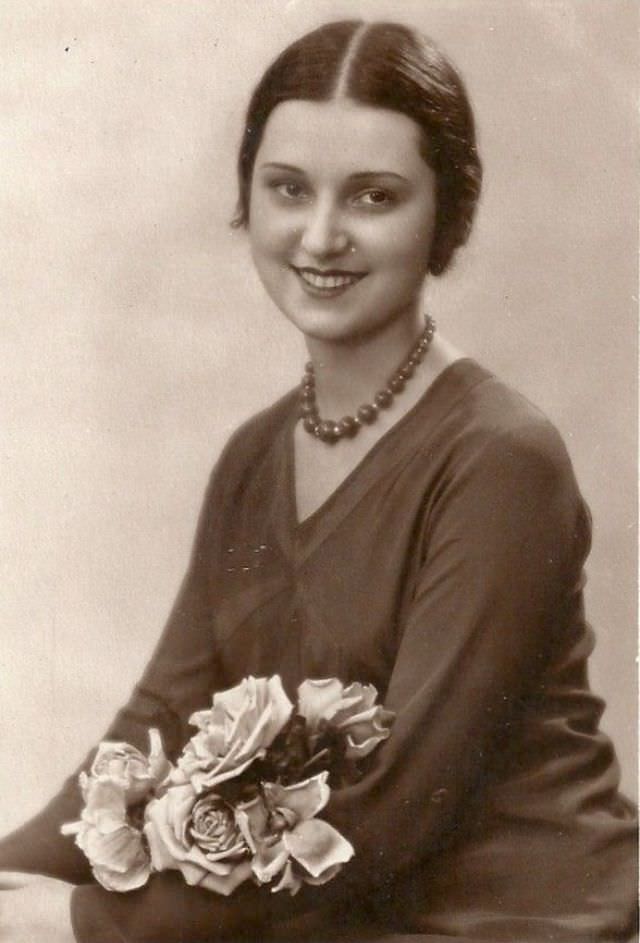
Poised and luminous, Miss Russia Irina Wentzel appears in a softly lit studio portrait that favors calm elegance over spectacle. Her hair is neatly parted and smoothed close to the head, framing a warm, confident smile that feels both formal and approachable. The plain backdrop keeps attention on her face and posture, a classic choice in early 20th-century portrait photography that helped define the era’s ideals of beauty.
A simple dress with long sleeves and a modest neckline speaks to restrained fashion sensibilities, while a single strand of beads adds a discreet note of glamour. In her lap, a bouquet of roses provides texture and romance, balancing the composition with gentle curves and pale petals against the darker fabric. Details like the soft focus and delicate tonal range give the image its period character, the kind of refined look often associated with 1930s beauty queens and European style culture.
Beyond the surface charm, the portrait hints at how pageant imagery was crafted to communicate grace, modernity, and respectability at once. Photographs like this were circulated to shape public fascination with “Miss” titles, linking personal poise to broader narratives of fashion and cultural taste. For anyone exploring vintage beauty, interwar portraiture, or the history of European pageants, Irina Wentzel’s image offers a timeless example of understated glamour.