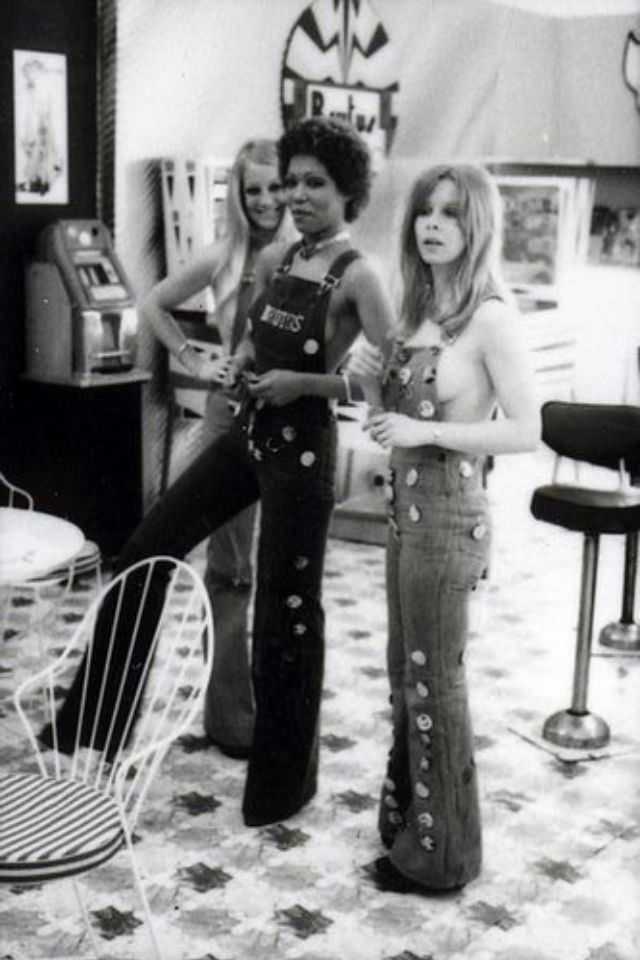
Three young women hold the room with a cool, unforced confidence, their poses as much a statement as the outfits themselves. Flared dungarees dominate the frame—one pair dark and sleek, another lighter and more casual—both decorated with bold patches and badges that turn workwear into wearable identity. The styling sits squarely in the orbit of late-1960s and 1970s British youth fashion, where playful customization and a hint of rebellion could be stitched, pinned, or pressed straight onto the body.
Behind them, the setting reads like a lively café or diner, complete with wire-frame seating, a patterned floor, and the glint of a bar stool to the right. A machine in the background and graphic wall décor add to the sense of modern leisure and pop-leaning design, the kind of everyday backdrop that made street style feel immediate and democratic. The contrast between the relaxed interior and the assertive silhouettes emphasizes how fashion was worn not for runways, but for real social spaces—places where music, conversation, and attitude mixed.
Brutus Fashion, as suggested by the title, isn’t just about clothing; it’s a photographic journey through British style and culture when self-expression accelerated. These dungarees and flares evoke a moment when youth trends borrowed from workwear, embraced the handmade, and celebrated individuality across friendships and scenes. As a piece of vintage fashion photography, the image offers a crisp snapshot of how 1960s and 70s style lived in motion—confident, communal, and unapologetically seen.