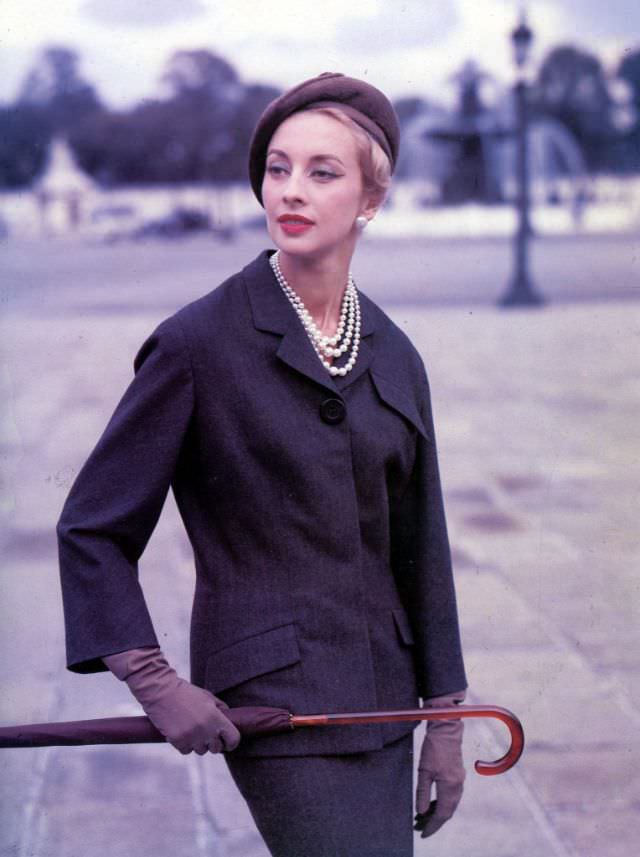
Marie-Thérèse stands poised in Pierre Balmain’s “Jolie Madame” flannel suit, a study in mid-century elegance where structure does the talking. The jacket’s clean, sculpted lines and oversized buttons emphasize a composed silhouette, while a dark beret frames her softly styled hair. Pearls at the throat and gloves at the wrist add the kind of polished restraint that defined high fashion in the 1950s.
Set against an open, slightly blurred outdoor backdrop with a lamppost and distant trees, the model’s turned gaze gives the scene a candid, editorial feel. The muted palette and gentle lighting let texture take center stage—flannel reading as both practical and luxurious, tailored for a woman moving confidently through public space. Even the curved handle of an umbrella becomes a prop of refinement, echoing the suit’s controlled geometry.
Balmain’s design language in this period celebrated “ladylike” modernity: impeccable fit, purposeful detailing, and accessories chosen for harmony rather than flash. “Jolie Madame” suggests not just a garment name but a cultural ideal—Paris couture translated into wearable authority for the postwar era. For fashion history, this image serves as a compact lesson in 1956 style, capturing how tailoring, pearls, and understated glamour worked together to signal sophistication.