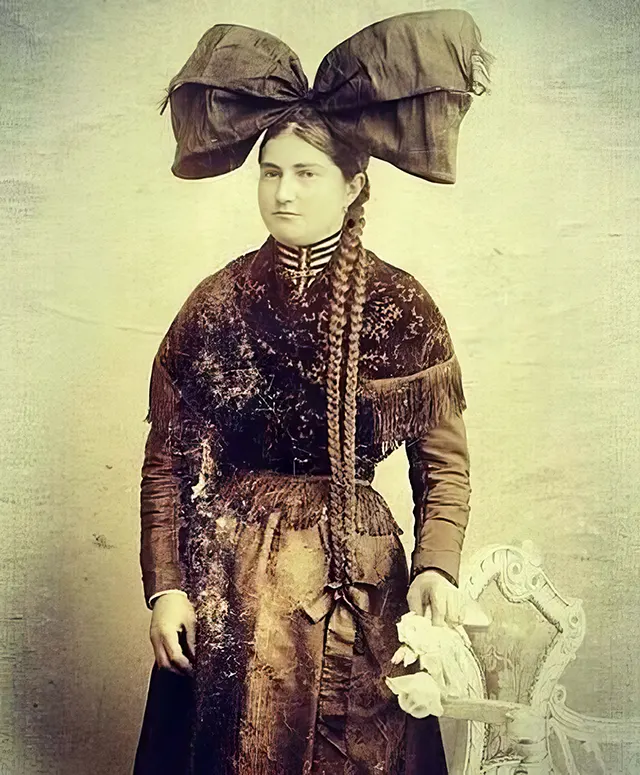
Poised before a plain studio backdrop, a young Alsatian woman faces the camera with a steady, unsmiling composure, her figure framed by the unmistakable Schlupfkapp—an oversized bow headdress that dominates the upper half of the portrait. The bow’s broad, dark folds read like sculpted fabric, balancing the long braid that falls down the front of her bodice. A high, striped collar and fitted sleeves add crisp structure, while a heavier outer layer drapes over her shoulders, its texture catching the light and the wear of time.
Clothing here functions as biography as much as fashion, with regional dress signaling community, status, and belonging in a borderland culture shaped by shifting influences. The Schlupfkapp, often associated with Alsace, turns the head into a kind of emblem, instantly legible even to viewers unfamiliar with the finer points of local costume. Subtle details—the neat fastening at the waist, the layered textiles, the carefully arranged hair—suggest a portrait made for remembrance, where identity is presented as deliberately as the pose.
Age marks the photograph itself: abrasions and fading speckle the dark fabric, and the softened tones lend a patina that feels archival and intimate. At the edge, a carved chair and a small bundle of light cloth in her hand hint at the studio setting and the etiquette of formal portraiture. For anyone searching Alsatian heritage, traditional headdress history, or European folk costume imagery, this portrait offers a striking, close view of how the Schlupfkapp endured as a visual symbol—part fashion statement, part cultural declaration.