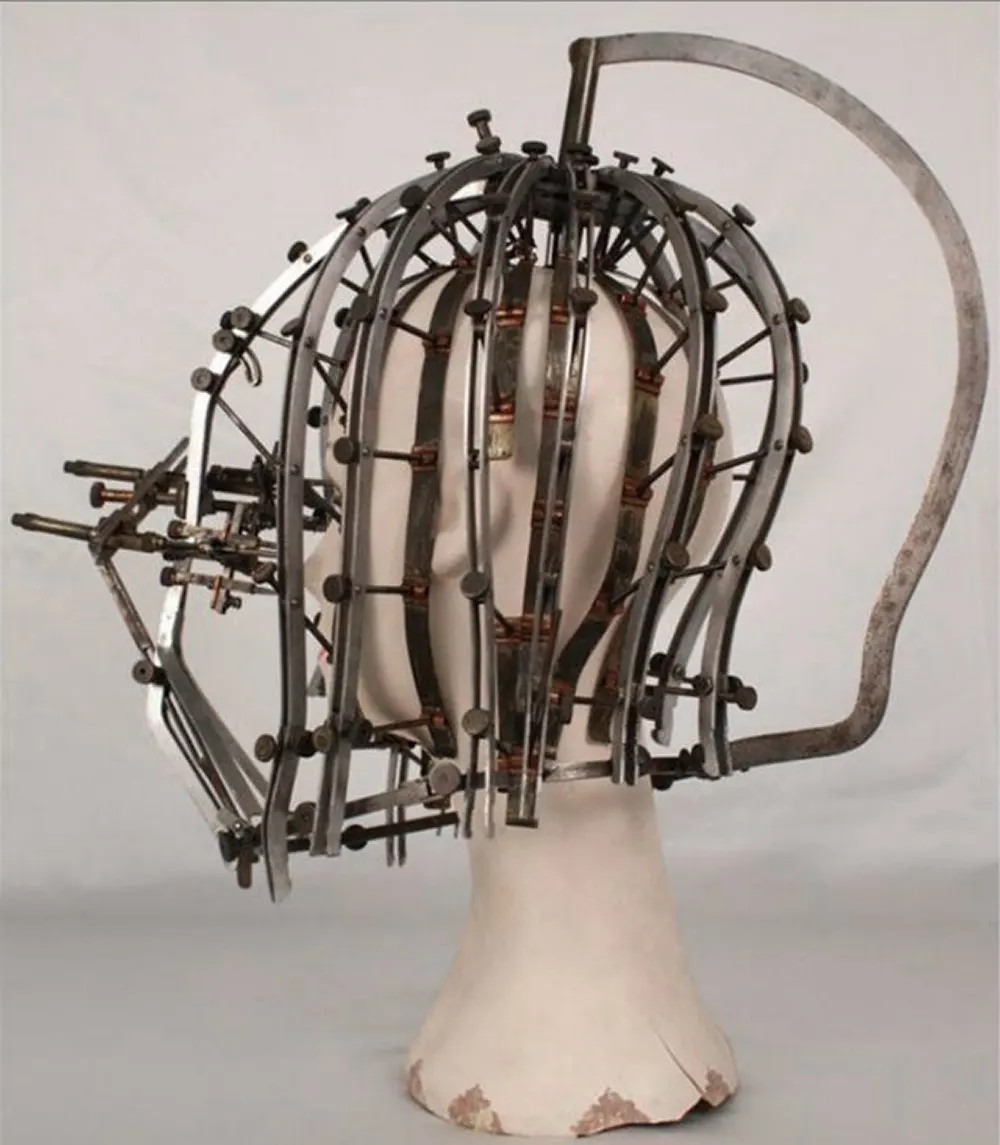
A cage of curved metal bands, screws, and sliding gauges wraps tightly around a featureless mannequin head, turning the human face into something that can be clamped, calibrated, and compared. The device’s intricate framework—part helmet, part measuring instrument—suggests careful adjustability, with knobs placed to press or align with the brow, cheeks, and jawline. Even without a person inside it, the “Beauty Calibrator” looks imposing, a mechanical promise that symmetry and proportion could be engineered.
Fashion and beauty culture in the 1930s often borrowed the language of science and modernity, and this contraption embodies that fascination with precision. By translating facial contours into measurable data points, it implied that “flaws” were not merely subjective but technical problems awaiting correction—through makeup technique, grooming advice, or even broader notions of self-improvement. The stark, clinical look of the apparatus sits in uneasy contrast to the soft ideals it aimed to produce.
Odd as it appears today, the Beauty Calibrator foreshadows later obsessions with standardized attractiveness, from cosmetic consultations to digital filters and facial-analysis apps. Its spidery architecture makes for a striking historical photo: a reminder that beauty standards have long been enforced not only by magazines and movies, but also by tools that claim authority through measurement. Seen through a modern lens, it reads as both a curiosity of design and a cautionary artifact of the era’s drive to quantify the face.