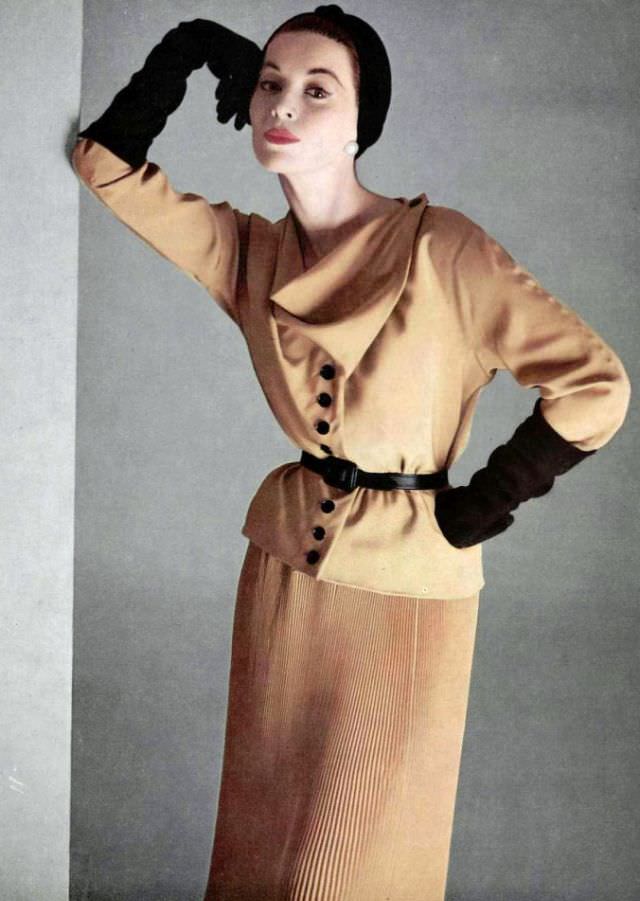
Joan Whelan poses with the cool assurance of early-1950s couture, her head wrapped in a dark cap and one gloved arm lifted in a sculptural gesture. A smooth studio backdrop keeps all attention on the silhouette: a fitted two-piece ensemble in silk crepe, cinched at the waist with a narrow belt and punctuated by a row of dark buttons. The styling—long gloves, pearl-like earrings, and a vivid lip—adds a note of evening sophistication to a look that still reads as sharply tailored daywear.
Jacques Fath’s design leans into contrast and control, pairing a soft, draped neckline with precise structure through the bodice. Below, the finely pleated skirt falls in clean, vertical lines that lengthen the figure and showcase the fabric’s movement even in stillness. The restrained palette and minimal set make the craftsmanship the subject, underscoring how couture photography could turn a garment’s construction into visual drama.
Pottier’s photograph carries the polished elegance that defined postwar fashion imagery, when couture houses relied on magazine-ready portraits to broadcast modern femininity and luxury. The composition highlights the narrow waist and measured volume—hallmarks of the era—while letting the pleats and buttons speak in crisp, graphic details. As a piece of fashion history from 1952, it documents the influence of French haute couture and the way style, culture, and photographic technique combined to sell an ideal of refinement.