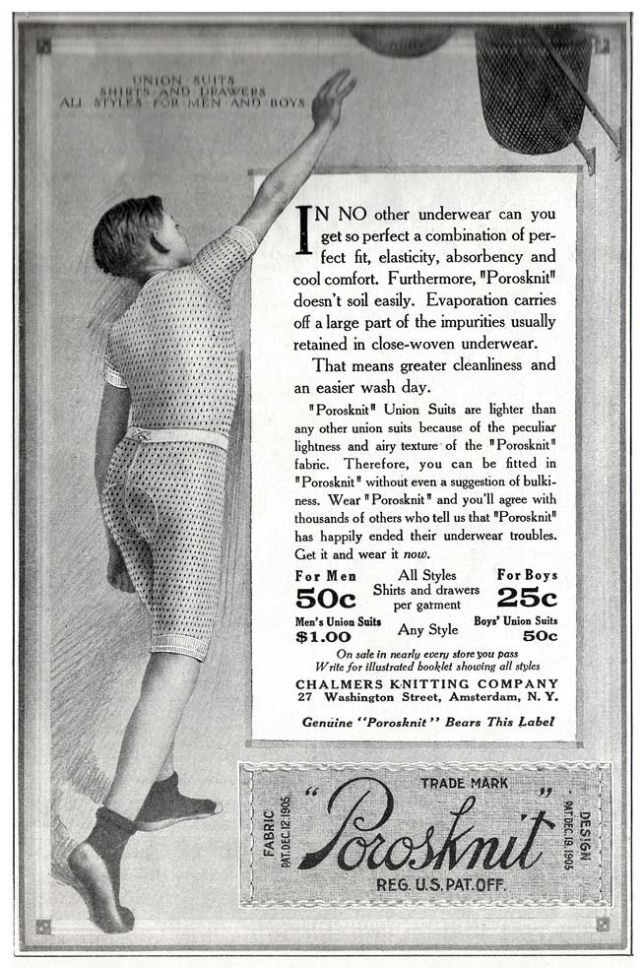
A boy in a perforated, short-sleeved union suit stretches upward as if reaching for a high window or pulling a cord, his pose turning everyday underwear into a scene of motion and modern comfort. The ad’s crisp layout frames him against a large block of text, letting the dotted knit pattern read clearly while keeping the emphasis on practicality. Even without a busy background, the illustration carries the early-1900s advertising habit of using a lively figure to sell an invisible promise: ease, cleanliness, and coolness next to the skin.
Typography does much of the heavy lifting, with a prominent drop-cap “I” starting a persuasive argument about “perfect fit,” “elasticity,” “absorbency,” and “cool comfort.” The language leans into hygiene and laundering—evaporation, impurities, and “an easier wash day”—revealing how fashion and culture overlapped with changing ideas about health, domestic labor, and the ideal masculine wardrobe. Claims about being lighter and less bulky suggest a market newly attentive to ventilation and freedom of movement, especially as knit fabrics and mass production improved.
Pricing and product categories anchor the sales pitch in everyday economics, listing options “For Men” and “For Boys,” along with “Union Suits,” “shirts and drawers,” and “all styles.” The manufacturer line for the Chalmers Knitting Company in Amsterdam, N.Y., plus the bold Porosknit trademark panel, gives the piece the look of a widely circulated magazine advertisement from the early 1900s. As a vintage fashion artifact, it’s a compact lesson in how underwear was branded not merely as clothing, but as technology—engineered fabric presented as the solution to discomfort and the pathway to respectable cleanliness.