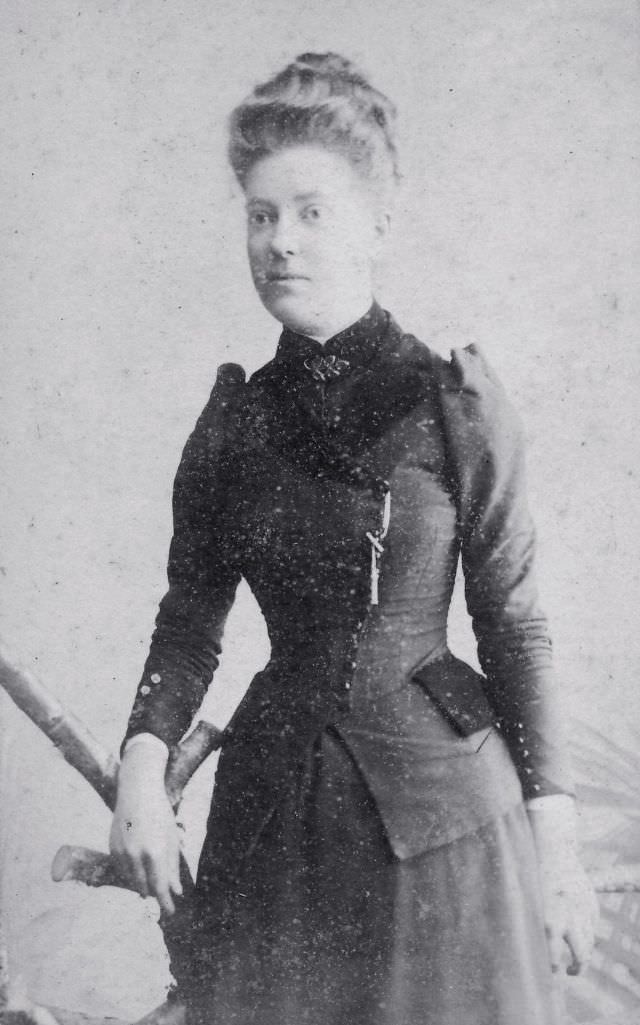
Poised against a plain studio backdrop, a Victorian woman stands with a steady, unflinching gaze, her hair swept up into a high, structured style that echoes the era’s preference for disciplined elegance. The fitted bodice and high collar draw the eye upward, while a small brooch at the throat adds a restrained note of ornament. Even through the soft grain and wear of the print, the silhouette reads clearly: upright posture, narrow waist, and carefully arranged layers intended to present composure and refinement.
At the heart of the look is the corset’s unmistakable influence, shaping the torso into the late 19th-century ideal and supporting the tailored lines of the outer dress. The fabric pulls smooth across the chest and hips, with crisp seams and a firm closure that suggest careful construction and a strong foundation garment beneath. Details like the long sleeves and snug cuffs reinforce the period’s modest fashion codes, while the overall cut reveals how undergarments dictated the architecture of women’s clothing from within.
Beyond fashion, the portrait hints at the cultural weight carried by Victorian-era dress: respectability signaled through restraint, status implied through fit and finish, and femininity defined by controlled form. Images like this have become key references for anyone researching Victorian women’s clothing, corsetry history, and late 19th-century fashion culture. As a surviving studio photograph, it also preserves the quieter reality behind the iconic hourglass figure—clothing engineered to be seen, but built upon an indispensable undergarment rarely shown outright.