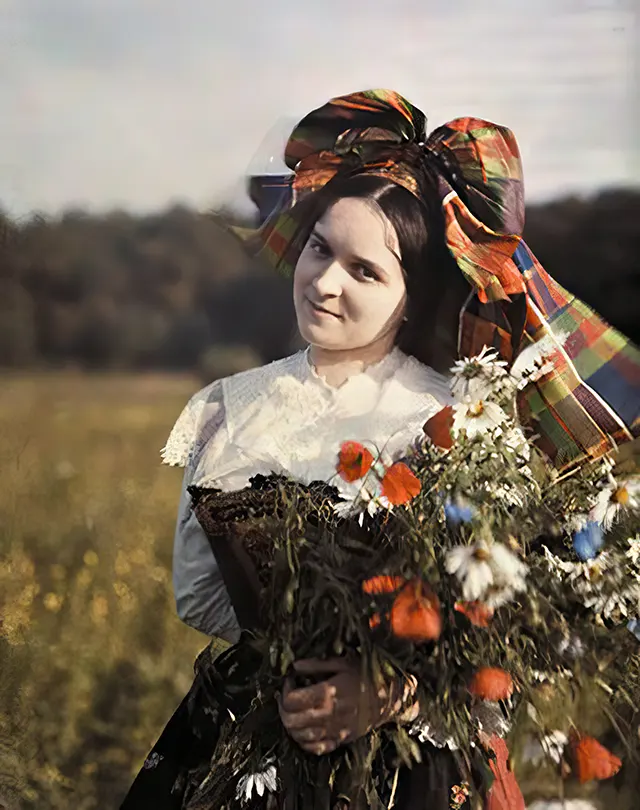
A young woman stands in a meadow with a quiet, self-assured gaze, dressed in traditional Alsatian attire that turns fashion into a statement of belonging. The most striking element is the Schlupfkapp—an oversized bow in vivid plaid—rising above her dark hair like a banner, its crisp folds and saturated colors drawing the eye immediately. In her arms she cradles a generous bouquet of wildflowers, their reds, whites, and blues echoing the richness of the textile and giving the portrait a celebratory, pastoral mood.
Seen alongside the lace of her blouse and the structured bodice of her dress, the headdress reads as more than ornament; it signals regional identity, family heritage, and the social rituals that once shaped everyday life. The contrast between delicate needlework and bold ribbon suggests the careful balance of practicality and display found in folk costume, where materials, patterns, and silhouettes carried meaning across generations. Even without a named place or date, the image evokes Alsace’s borderland culture and the way clothing can preserve memory when politics and borders shift.
Beyond costume history, the photograph works as a piece of cultural storytelling: a portrait that links land, labor, and celebration through the language of dress. The open field and soft horizon keep the focus on the wearer, while the bright Schlupfkapp anchors the composition as an emblem of Alsatian heritage. For anyone searching fashion and culture in Alsace—traditional headwear, regional identity, or European folk dress—this scene offers a vivid reminder that textiles can function like a living archive.