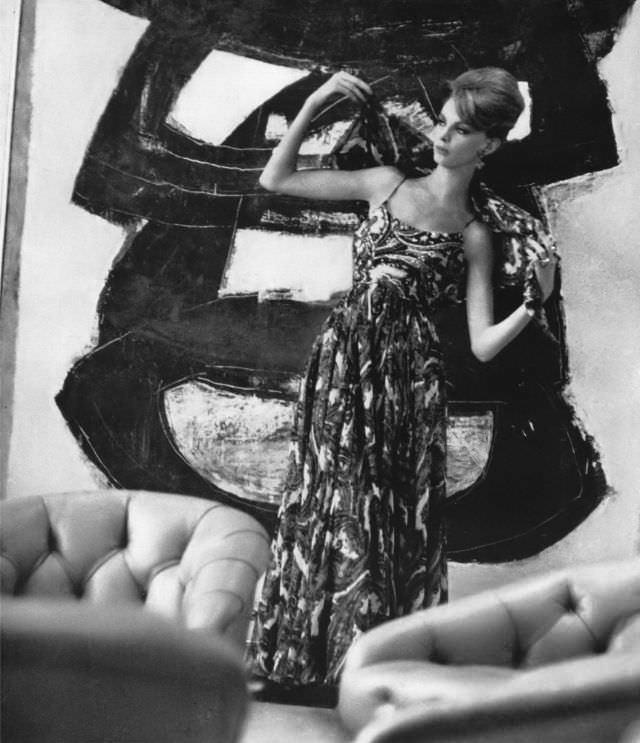
Leaning with a dancer’s poise against a wall-sized abstract canvas, Nena von Schlebrugge turns the patterned fall of a paisley chiffon dress into the scene’s true motion. Her sleeveless silhouette reads airy and elongated, the fabric pooling in soft, graphic waves that echo the bold, black brushwork behind her. The camera holds her in crisp relief while the foreground blurs into a low, upholstered curve, lending the composition a lived-in intimacy rather than a stagey glamour.
Modern art and mid-century fashion meet here with a kind of easy confidence typical of early-1960s style. The dramatic painting—more gesture than picture—frames her profile and lifted arm, as though the dress were another stroke in the artist’s palette. Chiffon’s lightness is suggested even in monochrome, translating print and transparency into tonal shimmer and shadow.
What lingers is the photograph’s balance between streetwise spontaneity and editorial polish, a hallmark of documentary-minded fashion photography of the era. Instead of relying on props or spectacle, the setting’s textures—canvas, plaster, and soft seating—create a cultural backdrop for a woman who appears both contemplative and self-possessed. As a piece of fashion and culture history, the image captures a moment when couture attitude could inhabit everyday interiors, and when a single printed dress could converse fluently with the avant-garde.