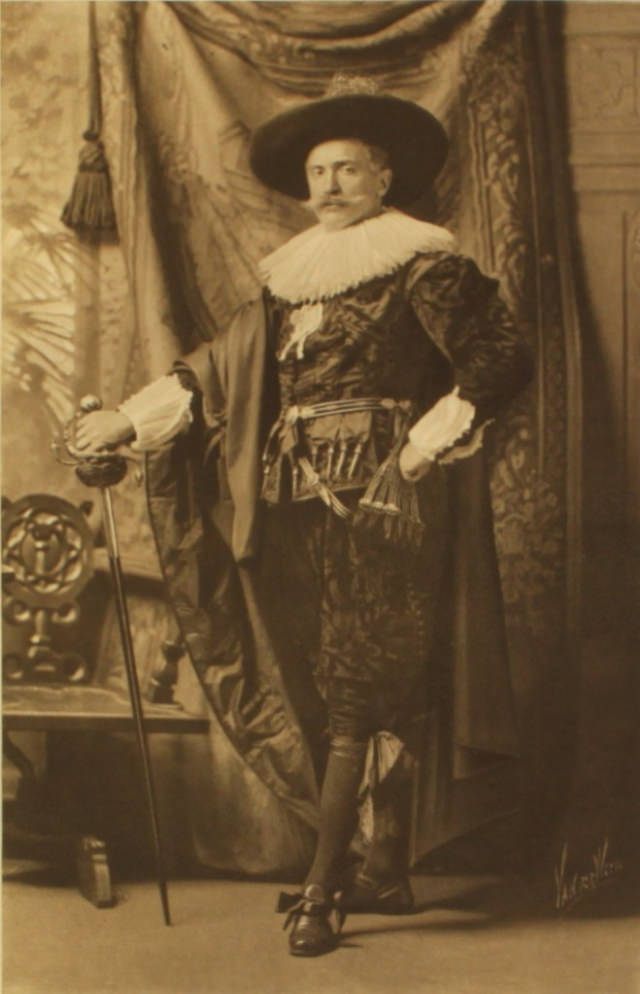
Sir Edgar Vincent stands in confident three-quarter pose, dressed to evoke the swagger and refinement of a Franz Hals portrait. A broad, dark hat frames his face, while a crisp ruff collar and richly patterned doublet create that unmistakable 17th-century silhouette, finished with a sword at the hip. One hand rests on a cane and the other settles at his waist, turning costume into character with a practiced air.
Behind him, draped textiles and carved furnishings suggest a studio-like setting designed to flatter both the sitter and the outfit, echoing the theatrical staging of old-master painting. The sheen of the fabric and the layered accessories—cape, cuffs, belt, and scabbard—signal how carefully such ensembles were assembled for maximum effect under late Victorian photographic lighting. Even the stance feels borrowed from painted precedent, translating brushwork bravura into a formal, posed photograph.
Linked to the famed Devonshire House Ball of 1897, the image belongs to a moment when elite society treated historical dress as spectacle and cultural reference, not merely fancy dress. Guests drew on art history to project lineage, taste, and cosmopolitan education, and Hals—celebrated for lively portrayals of Dutch civic life—offered a particularly dashing template. For readers interested in Victorian costume, Gilded Age pageantry, and the intersection of fashion and culture, this portrait captures how a single evening could become an homage to the past, staged through fabric, pose, and photographic permanence.