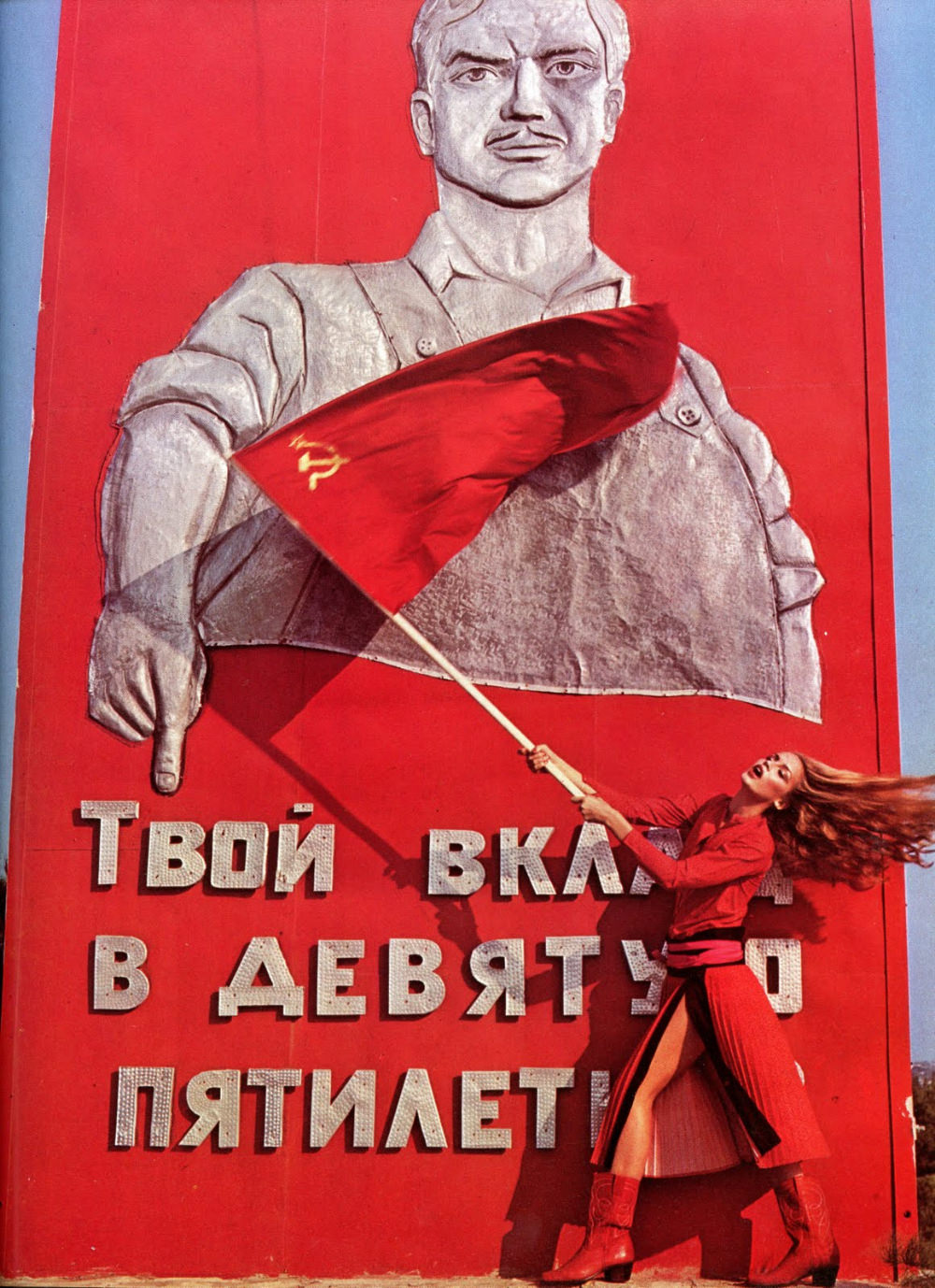
Against a towering field of revolutionary red, Jerry Hall is caught mid-gesture as wind lifts both her hair and a bright flag, turning the scene into pure motion. Behind her looms a monumental propaganda-style figure rendered in stark tones, with bold Cyrillic lettering anchoring the composition like a public declaration. The contrast between the rigid mural and Hall’s exuberant pose creates the kind of visual tension that made 1970s fashion photography feel daring, cinematic, and alive.
Norman Parkinson’s eye for scale and spectacle is evident in the way the model is placed at the edge of the frame, dwarfed yet unmistakably commanding. A saturated palette—red on red, punctuated by pale stone hues and crisp shadows—pushes the image into graphic poster territory while still reading as a Vogue fashion moment. Hall’s styling, with a flowing coat and high boots, echoes the decade’s confident silhouette and turns street-level architecture into a dramatic runway.
More than a glamorous portrait, the photograph works as a piece of fashion and culture: a collision of couture attitude with the visual language of state messaging. The Cyrillic text and heroic mural suggest a public space shaped by ideology, while the model’s playful defiance reframes it as backdrop for style and performance. It’s a memorable 1975-era British Vogue image that captures how editorial fashion could borrow from the world’s symbols and return them as bold, unforgettable art.