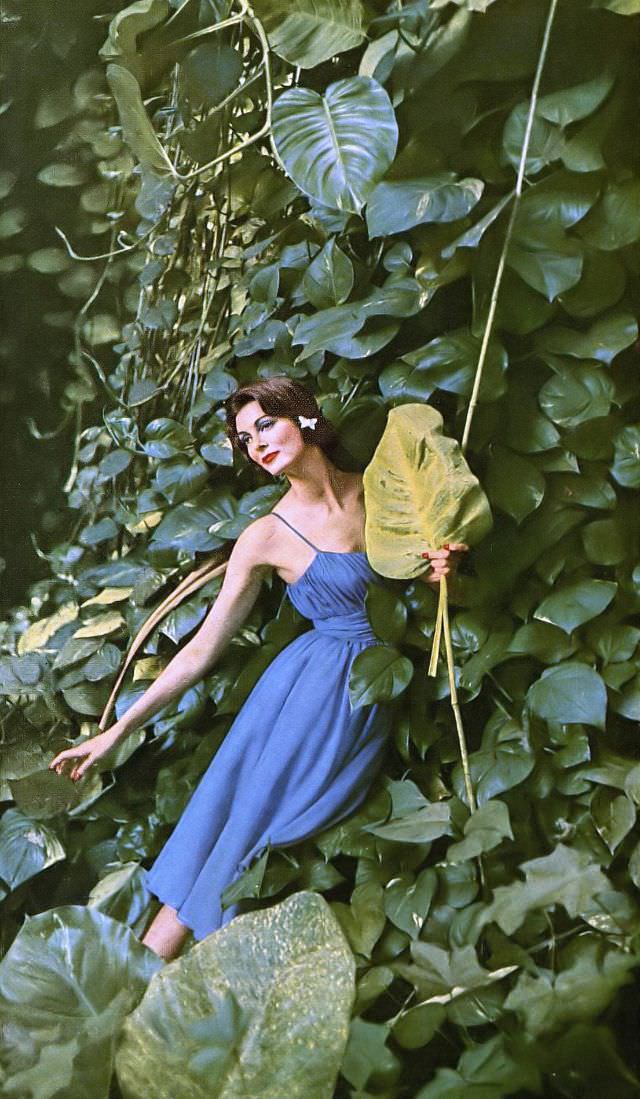
Against a wall of glossy tropical foliage, Carmen Dell’Orefice reclines as if the jungle itself were a boudoir, her gaze turned slightly away in a poised, editorial daydream. A slim-strap blue evening dress—identified as Supima cotton by designer Jerry Parnis—falls in clean, mid-century lines, its cool tone strikingly calm against the dense greens. One oversized leaf is lifted like a fan or shield, a playful prop that echoes the botanical scale surrounding her.
Gleb Derujinsky’s fashion photography here leans into contrast: cultivated glamour set inside exuberant nature, with the model’s pale silhouette and sculpted makeup emerging from shadowed leaves. The composition is lush and immersive, vines and heart-shaped leaves forming a textured backdrop that frames the dress and the sitter’s elongated pose. The image’s color palette—blue fabric, green canopy, and warm skin tones—does much of the storytelling, turning a simple styling moment into a memorable Harper’s Bazaar tableau.
Published in Harper’s Bazaar in January 1959 and shot in Hawaii, the photograph speaks to an era when magazines sold not only clothing but an escapist atmosphere—resort romance, modern elegance, and the promise of faraway light. Supima cotton, typically celebrated for its softness and quality, is presented here with eveningwear sophistication, blurring the line between practicality and couture allure. Seen today, it remains a vivid example of late-1950s fashion editorials: polished, theatrical, and unmistakably designed to be remembered.