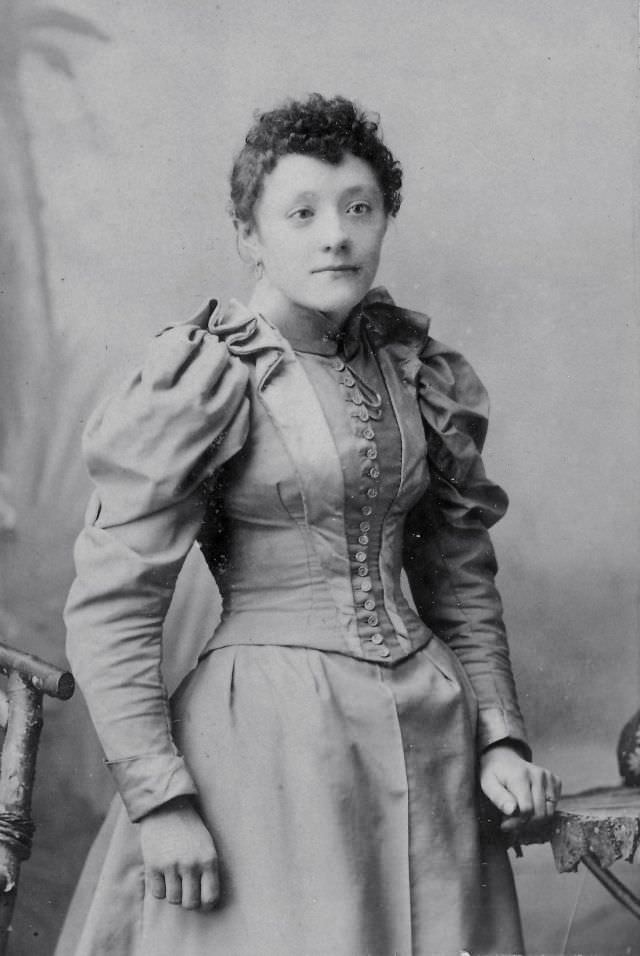
A young Victorian woman stands in a studio setting, her posture composed and her gaze directed slightly off-camera, as if caught between formality and quiet confidence. The plain backdrop and soft lighting pull attention to her silhouette, while a chair and table edge at the sides hint at the familiar props of late 19th-century portrait photography. Her hair is neatly arranged, and her expression remains calm, lending the scene a restrained intimacy typical of the era’s posed images.
The dress itself tells the larger story of the “indispensable undergarment” beneath: the tightly fitted bodice narrows the waist and smooths the torso, revealing the shaping influence of a corset without exposing it. Rows of buttons march down the front, and the fabric is structured into panels that emphasize a fashionable hourglass line. Dramatic puffed sleeves at the shoulders and a full skirt balance the cinched midsection, illustrating how Victorian women’s fashion relied on engineering as much as ornament.
Seen through a fashion-and-culture lens, the portrait becomes more than a pretty costume study; it’s evidence of how ideals of respectability, femininity, and class were stitched into everyday clothing. Corsetry functioned as foundation wear, posture aid, and social signal, influencing how women moved, sat, and were photographed for the family album. For readers searching Victorian corsets, late 19th-century women’s clothing, or historical undergarments, this image offers a clear, human-scale glimpse of how the era’s celebrated silhouette was built.