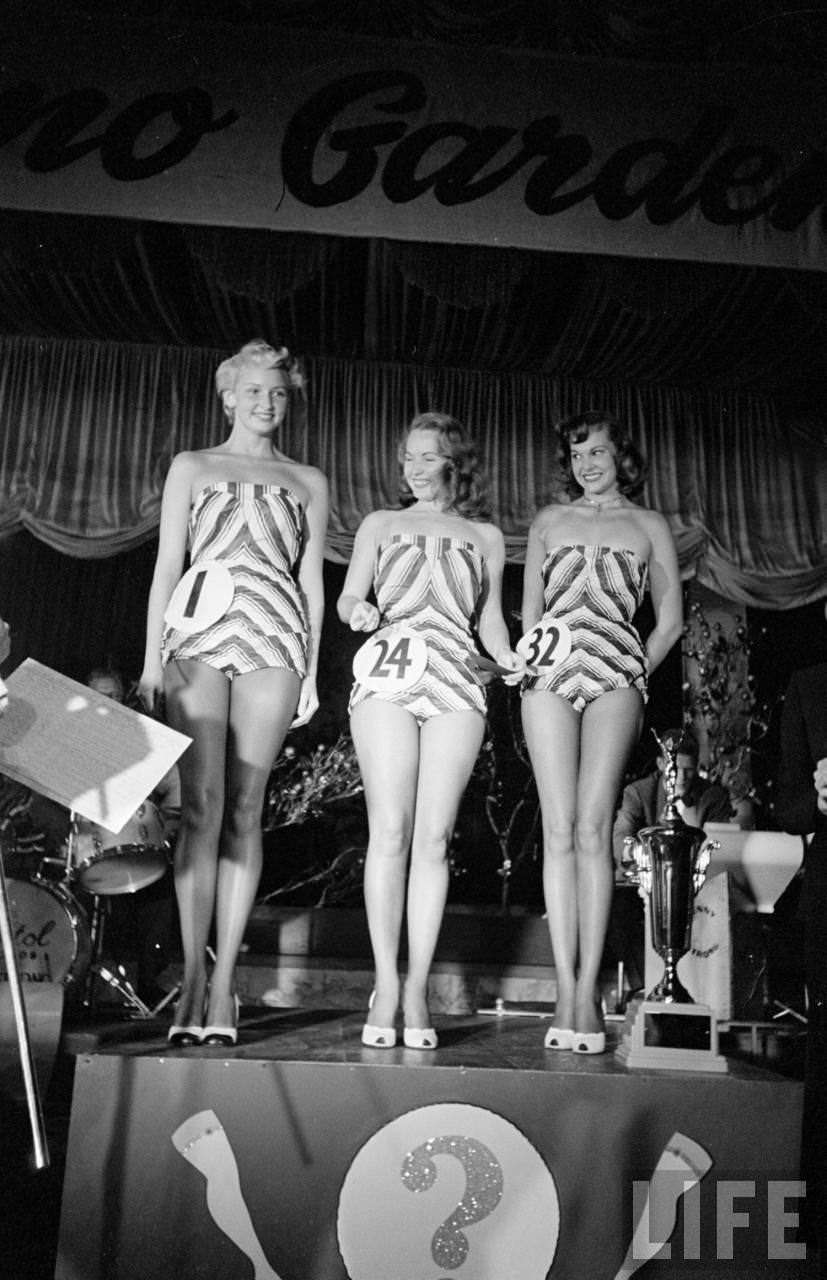
Spotlights fall across a small stage where three contestants pose with practiced ease, each wearing a striped one-piece that reads unmistakably mid-century. Pinned numbers—“24” and “32” clearly visible—turn the lineup into a judged contest rather than a casual revue, while their smiles suggest the upbeat confidence of postwar American entertainment. Behind them, pleated curtains and a partially visible banner hint at a sponsored show, the kind of glamorous nightlife spectacle Los Angeles was known for in 1949.
On the floor below, a large question mark decoration teases the crowd with the promise of a winner, and a shiny trophy waits at stage right like the final punctuation to the evening. A live band sits in the shadows—drums and brass peeking through—adding swing-era energy that bridges wartime big-band culture and the emerging pop sheen of the 1950s. The scene feels half pageant, half nightclub act, with the audience kept just out of frame but clearly present in the performers’ fixed, front-facing stance.
Leg-focused beauty competitions were a curious slice of fashion and culture, reflecting how Hollywood-adjacent cities marketed glamour through body ideals, swimwear trends, and stagecraft. The bathing suits’ bold chevrons and the identical heels speak to a standardized look designed to compare contestants at a glance, while the numbered badges make the women both individuals and entries on a scorecard. As a historical photo, it preserves more than a contest—it captures the choreography of mid-century femininity, the commercial theater of Los Angeles nightlife, and the era’s belief that style could be measured, ranked, and awarded.