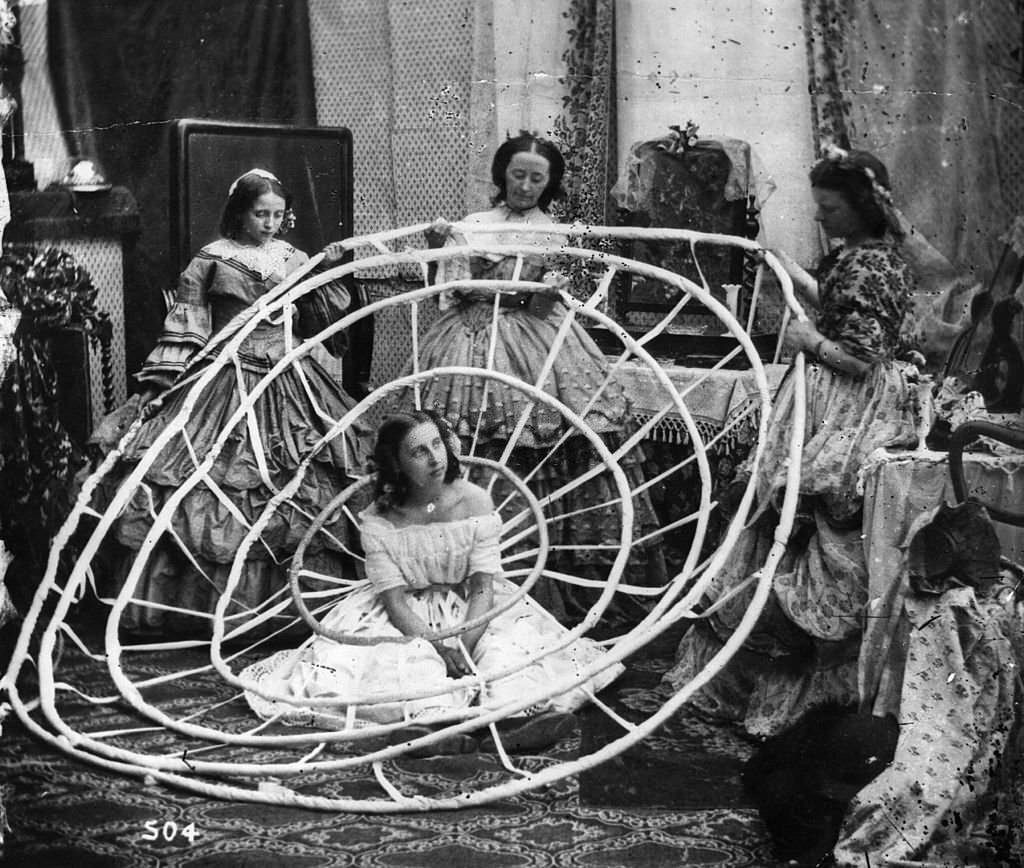
In a crowded interior, several women in layered nineteenth-century gowns gather around an enormous cage of hoops, its pale ribs arcing like the frame of a tent across the patterned carpet. One woman sits low within the structure, while others stand at the edges, their attention fixed on the unwieldy circle that dominates the room. Behind them, draped fabrics, furniture, and soft clutter create the feel of a dressing space where fashion is handled as carefully as any craft.
The scene illustrates the practical reality behind the crinoline silhouette: a dress so wide that it can require assistance—and in this case long poles—to lift and guide fabric over the hoops. Hands and tools work together to tame the springy framework, aligning it so the skirt will fall evenly rather than snag or collapse. What looks effortless in portraits becomes here a small production, revealing the labor, coordination, and patience hidden inside a single fashionable look.
Beyond its novelty, the photograph offers a vivid window into Victorian-era clothing technology and the social rituals of getting dressed. The crinoline, celebrated for its dramatic volume, also reshaped domestic space, demanding room to move and helpers to manage its scale. For anyone researching 19th-century women’s fashion, dressmaking, or cultural history, this image turns an iconic garment into a lived experience—awkward, communal, and unmistakably theatrical.