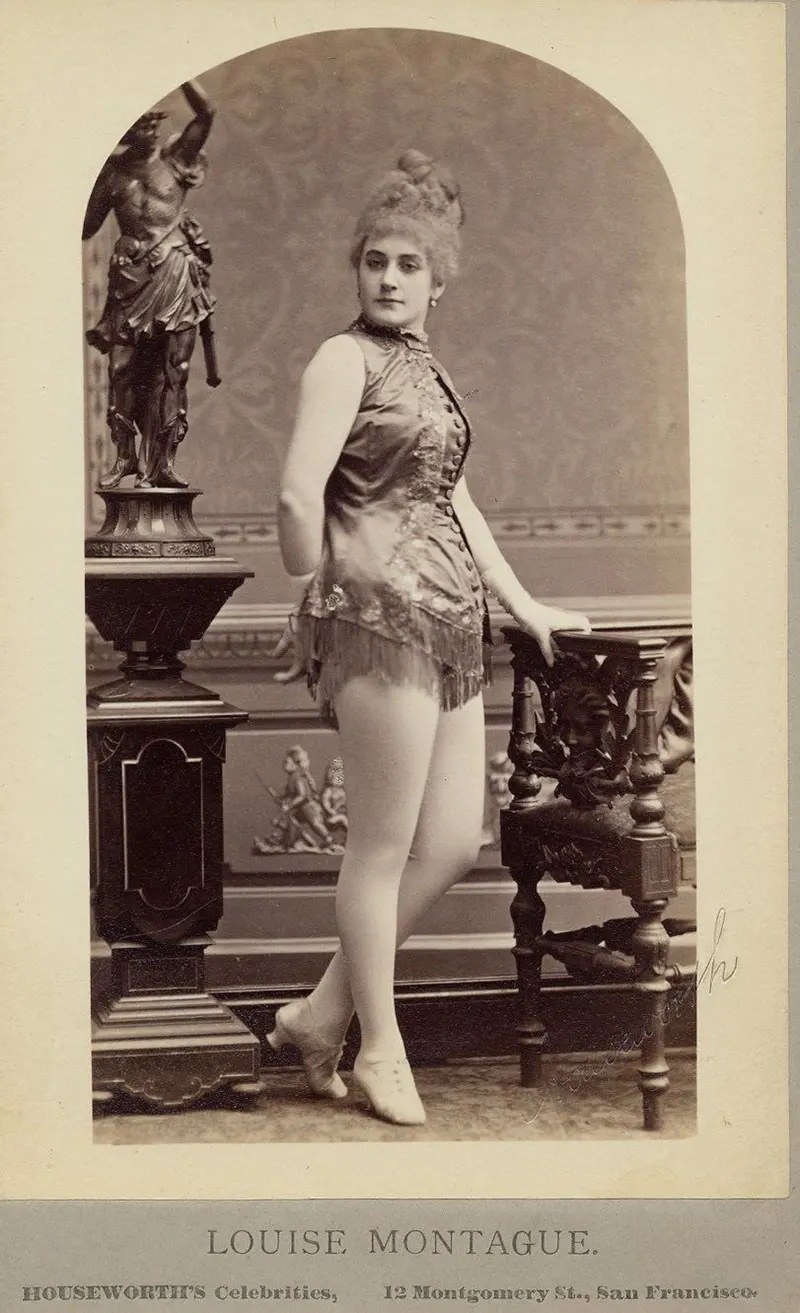
Louise Montague stands in a poised studio pose, her body turned in profile as she rests one hand on an ornate chair and lets the other fall behind her hip. The theatrical set—carved furniture, patterned backdrop, and a classical statue perched on a pedestal—frames her as a stage personality meant to be admired, not merely documented. Even without motion, the stance suggests performance: chin lifted, gaze steady, and posture calibrated for the camera’s long look.
Her costume does most of the talking: a short, fitted mini dress trimmed with fringe that would have shimmered with every step under footlights. The front is fastened with a row of buttons, and the tailored bodice meets a hemline that reveals stockinged legs and neat, lace-up boots—details that signal burlesque and late-Victorian entertainment culture rather than everyday fashion. Texture is emphasized throughout, from the sheen of the fabric to the dangling fringe that reads as both playful and daring.
At the bottom of the print, her name appears clearly—“LOUISE MONTAGUE.”—alongside the imprint for Houseworth’s Celebrities, with an address in San Francisco, anchoring the portrait within the commercial world of celebrity photography. Such images functioned as publicity as much as portraiture, circulating performers’ likenesses and their “interesting costumes” to audiences eager for theatrical glamour. As a piece of fashion and culture history, the photograph captures how late-19th-century burlesque blended spectacle, modern style, and carefully staged respectability into a single collectible card.