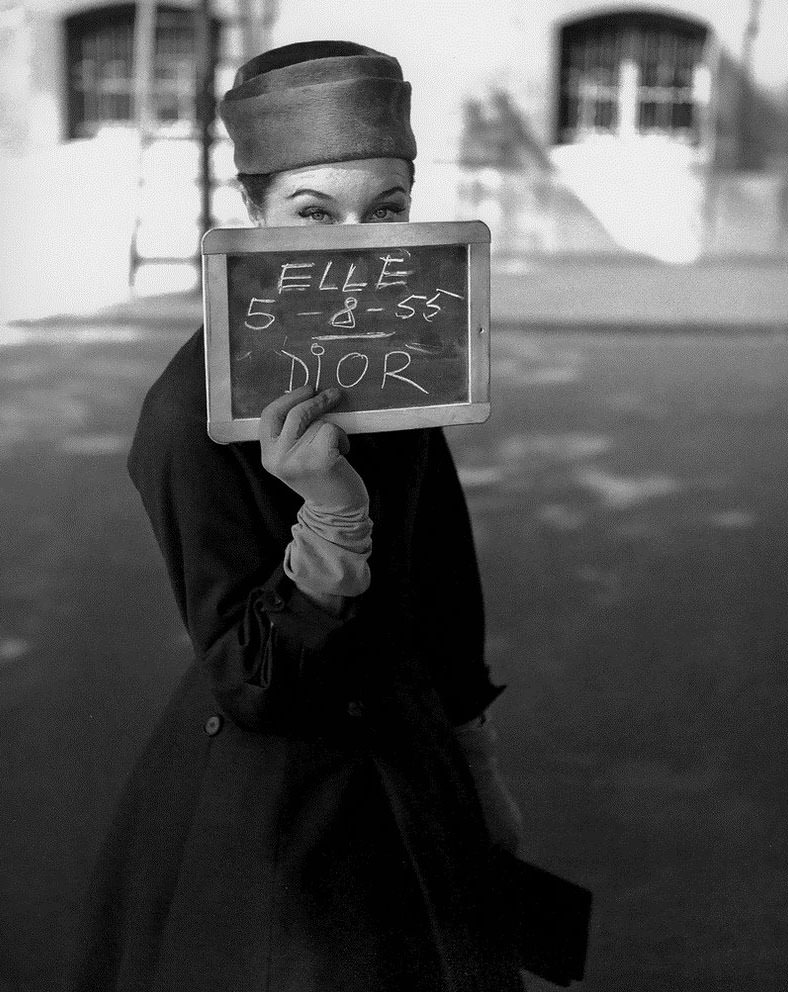
Bettina Graziani stands poised in a mid-century street scene, her gaze directed straight at the camera while a small chalkboard masks the lower half of her face. Written on it are the magazine cue “ELLE,” the date “5-8-55,” and “DIOR,” turning a playful prop into a crisp record of editorial fashion work. A structured pillbox-style hat and dark, impeccably tailored outerwear frame her eyes, which become the image’s focal point.
The photograph balances spontaneity with couture discipline: gloved hands, a fitted waist, and clean lines suggest Christian Dior’s refined silhouette, even as the blurred background keeps attention on the model’s controlled elegance. The board functions like a behind-the-scenes slate, hinting at the production rhythms of 1950s fashion photography and the collaboration between magazine, house, and model. Light and shadow add depth to the fabric, emphasizing texture and the sculptural quality of the look.
As a document of Fashion & Culture, the scene captures the moment when French couture and mass-circulation style magazines shaped modern glamour. Bettina Graziani’s presence—at once intimate and reserved—speaks to the era’s ideal of sophistication, where personality was conveyed through posture, accessories, and a single, memorable look. For readers searching “Bettina Graziani wearing Christian Dior, 1955,” this image offers both iconography and context: a stylish portrait that also reveals the mechanics of how fashion history was made.