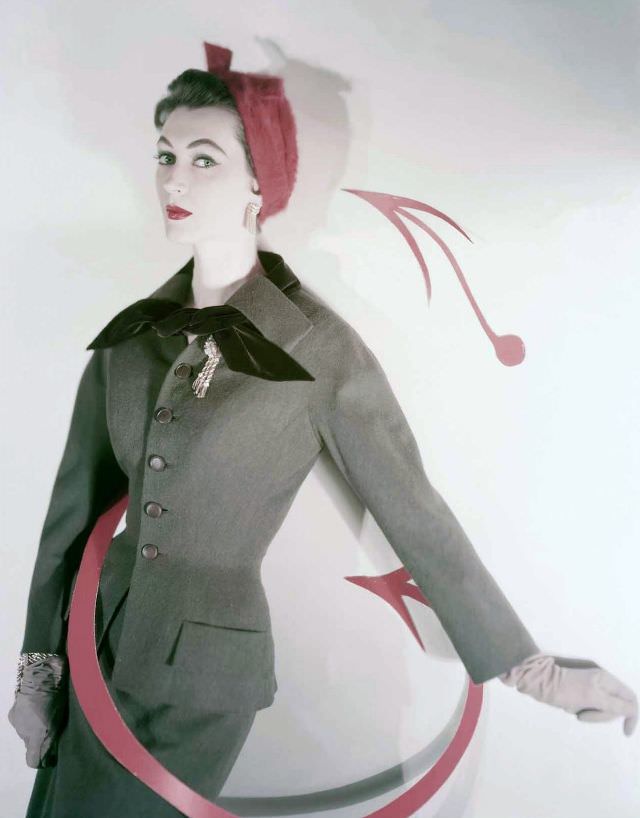
Dovima stands in poised three-quarter profile, her gaze cool and deliberate, wearing a taupe wool-and-velvet suit by Ben Zuckerman that skims the waist and falls in a clean, tailored line. The jacket’s sculpted shoulders and neat row of buttons read as pure early-1950s polish, while a dramatic black velvet collar frames her neck like a bow of shadow. A brooch catches the light at the lapel, and pale gloves extend the look into the realm of formal elegance.
Above her dark, carefully styled hair sits a vivid red hat by Jacques Fath, a striking accent that punctuates the otherwise restrained palette. Horst P. Horst’s fashion photography turns the ensemble into graphic design: a pale backdrop becomes a stage for sweeping red brushstrokes that echo the hat’s color and guide the eye around her silhouette. The controlled lighting, the crisp edges of the suit, and the selective sparkle of jewelry create a refined tension between softness and structure.
Used for the cover of Vogue in 1953, the image embodies mid-century fashion’s confidence in couture-like tailoring and carefully chosen statement pieces. It also highlights the era’s collaboration between model, designer, and photographer—where clothing, pose, and set decoration work together as a single visual argument for modern glamour. For anyone searching classic Vogue cover history, Horst P. Horst portraits, or 1950s haute fashion styling, this photograph remains an enduring reference point.