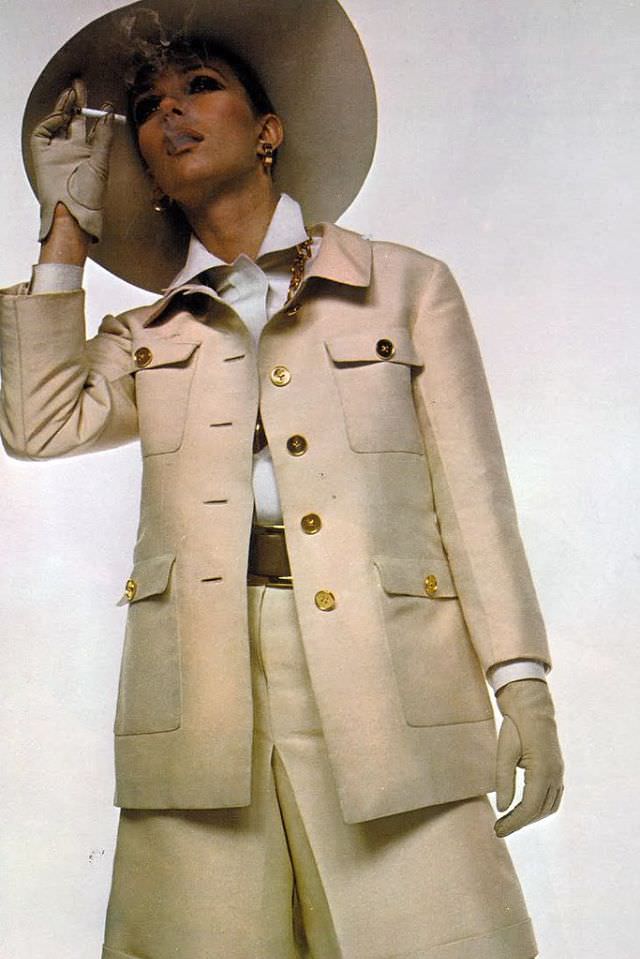
Nicole de la Marge stands in a poised, upward-angled portrait that makes her appear statuesque, the brim of a wide safari hat cutting a crisp silhouette against a pale studio sky. A cigarette lifted in a gloved hand adds a note of controlled nonchalance, while gold hoop earrings and a short chain necklace catch the light like punctuation. Her gaze is turned away from the viewer, reinforcing the editorial mood of 1960s fashion photography—distant, modern, and self-possessed.
Nina Ricci’s silk pongee safari suit is rendered in a soft, sand-toned palette that leans into the decade’s fascination with travel-inspired tailoring and refined utility. The jacket’s oversized patch pockets, prominent buttons, and structured collar translate fieldwear details into Parisian elegance, balanced by a clean white blouse and a slim belt that cinches the waist. Matching gloves and coordinated separates keep the look disciplined, proving how couture houses could borrow the language of adventure while remaining unmistakably polished.
In 1967, images like this helped cement the safari suit as both a cultural signifier and a wardrobe solution—practical lines reimagined for the city, photographed with cinematic restraint. The minimal background and low viewpoint highlight fabric, cut, and attitude, turning clothing into narrative rather than mere product. For readers searching the history of Elle-era style, Nicole de la Marge’s editorial presence here captures a moment when French fashion fused glamour with utility, and made it look effortless.