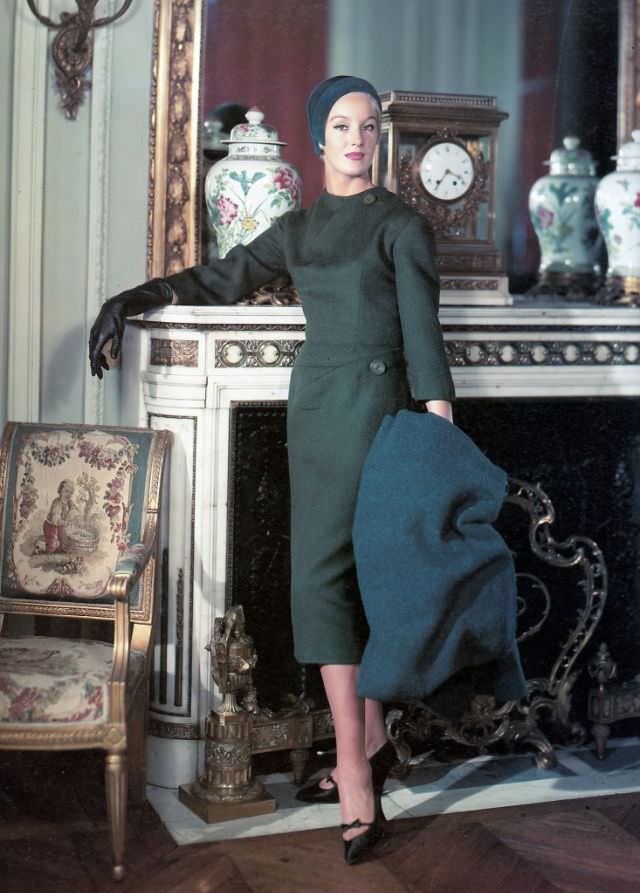
Barbara Cailleux stands with poised assurance beside an ornate mantel, modeling a Balmain town dress and coat ensemble from 1958. The look is elegantly restrained: a dark, fitted sheath with bracelet-length sleeves and subtle button detailing, paired with a matching coat draped over her arm like an accessory in its own right. A sleek head covering and long gloves sharpen the silhouette, while low heels keep the line practical for the city—quiet luxury rendered in mid-century couture discipline.
Behind her, a richly decorated interior frames the fashion story with period opulence: a carved clock centered on the mantel, flanked by large floral porcelain urns, and gilded trim catching the light. The patterned upholstery of a nearby chair and the polished floorboards deepen the sense of a private salon, the kind of setting that couture photography often used to suggest lineage, taste, and cultivated ease. Color photography lends the scene a vivid immediacy, turning the refined palette into a mood rather than mere documentation.
Balmain’s 1950s designs were celebrated for their architectural clarity, and this town dress embodies that reputation—structured without stiffness, formal without excess. The styling underscores the era’s ideal of composed femininity, where accessories were chosen to amplify line and posture rather than compete for attention. As a piece of fashion history and culture, the image reads like a lesson in how haute couture translated into daywear: impeccably made, socially legible, and designed to move through public life with authority.