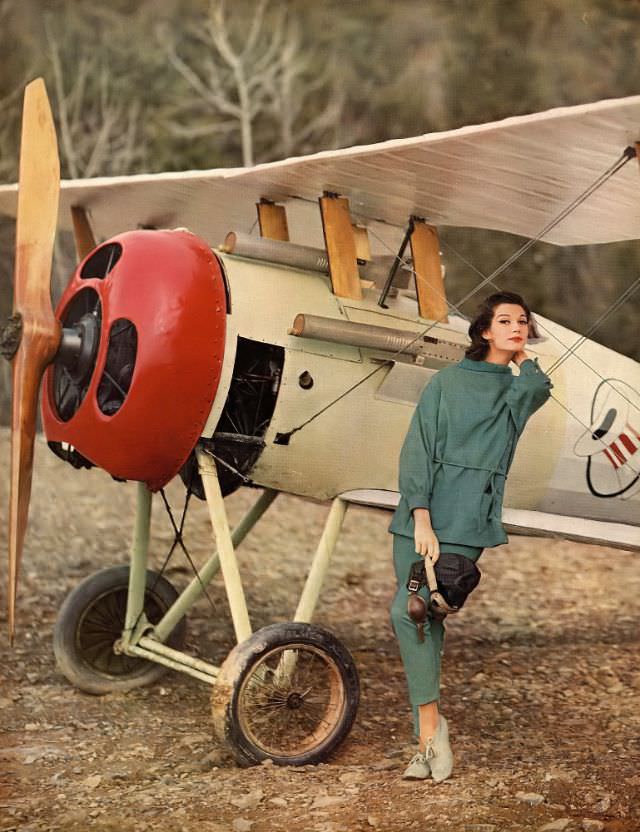
Against the pale wing of a vintage biplane, Simone d’Aillencourt stands with an easy, assured poise, her gaze turned outward as if listening for the next cue. The aircraft’s bold red engine cowling and weathered landing gear ground the scene in tactile detail—metal, wood, and canvas set off by a scrubby outdoor backdrop. In her hand, a pair of aviation goggles becomes a small but telling prop, linking high fashion to the era’s enduring fascination with flight.
The blue suede tunic top and slim trousers by Samuel Robert read as streamlined and modern, a mid-century answer to the practical romance of travel. Soft structure, a cinched waist, and tapered legs echo the biplane’s functional geometry, while the suede’s matte richness contrasts with the plane’s hard surfaces. Even without ornate embellishment, the outfit projects luxury through material and cut, turning utilitarian inspiration into Harper’s Bazaar–ready elegance.
Gleb Derujinsky’s fashion photography thrives on this kind of juxtaposition, pairing couture with industrial icons to create narrative rather than mere display. The styling invites viewers into a 1959 mood of optimism—adventure suggested, not staged—where a model can inhabit the space between runway refinement and open-air mechanics. For collectors of Harper’s Bazaar archives and historians of 1950s fashion, the image offers a crisp snapshot of how glamour absorbed modern technology and made it wearable.