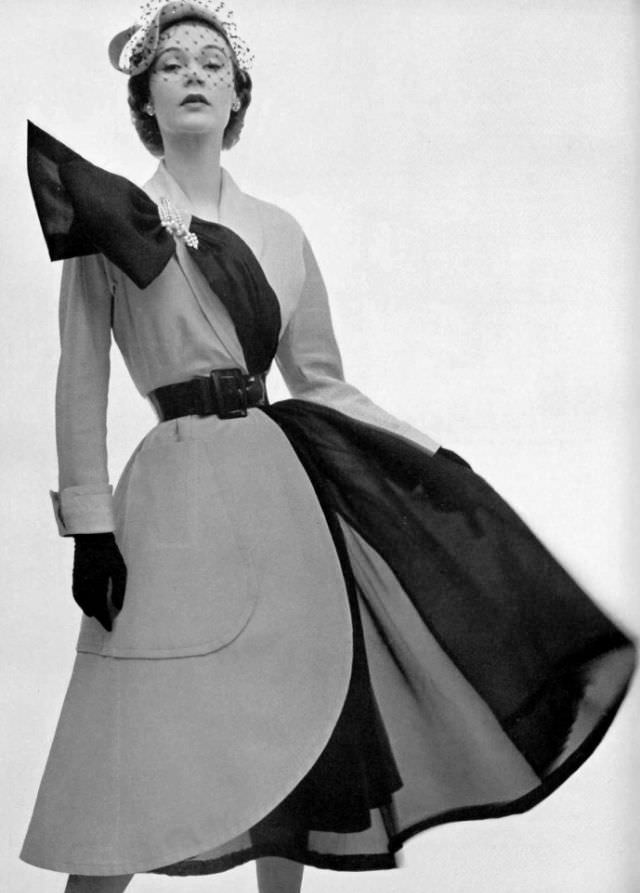
Poised against a clean studio backdrop, Sophie Malgat models a striking early-1950s silhouette that balances softness and structure. A small hat with a dotted veil frames her face, while dark gloves and a confident, lifted chin lend the portrait the cool authority of postwar couture imagery. The camera angle looks slightly upward, turning the model into a tall, graphic figure—part runway moment, part fashion illustration brought to life.
The outfit credited to Jacques Fath is all about contrast: a beige alpaca coat dress cinched tightly with a wide belt, worn over a black organza skirt that sweeps outward in motion. The design reads as both practical and theatrical, with crisp cuffs and a bold, curved panel that draws the eye across the body. As the hem flares, the darker underlayer appears like a shadowed wave, emphasizing movement and the careful engineering of haute couture textiles.
Fashion photographs from this period often celebrated controlled drama, and this image leans into that language—wind or a deliberate turn animates the skirt, showing how the garment performs rather than merely hangs. The look is quintessential 1951: tailored waist, elegant accessories, and a mix of luxury fibers that signal prosperity and modernity after the austerity of the 1940s. For anyone searching mid-century French fashion, Jacques Fath couture, or Sophie Malgat’s early-1950s modeling, the photograph serves as a concise visual summary of the era’s glamorous precision.