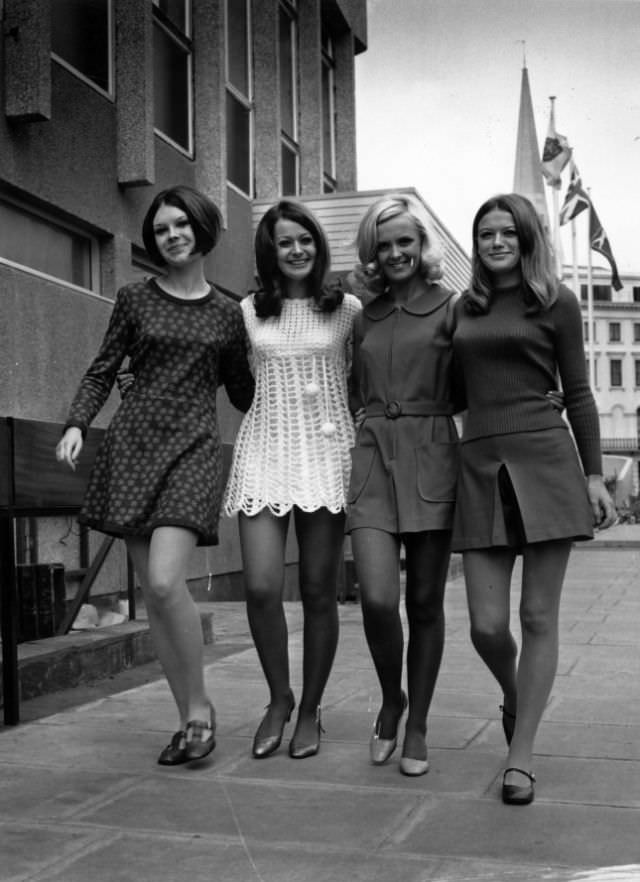
Four young women stride down a city pavement with the easy confidence that defined so much of 1960s youth style. Their silhouettes are unmistakably of the era—short hemlines, neat lines, and a polish that reads as modern even now—set against hard-edged urban architecture and a row of flags fluttering in the background. The photo’s street-level perspective turns an everyday walkway into a runway, where attitude matters as much as fabric.
Fashion here speaks in the visual shorthand of the decade’s style wars: streamlined dresses, a crisp shift shape, and a belted mini that nods to the mod taste for clean geometry and pared-back chic. Hosiery and low, practical heels keep the look sharp and mobile, suggesting a generation dressed for movement—dancing, commuting, meeting friends—rather than for sitting still. Even the hairstyles, sculpted yet natural, echo that same balance between precision and personal flair that made 60s fashion feel revolutionary.
While the title invokes Mods and Rockers, the image leans into the mod side of the cultural tug-of-war: city-smart, boutique-ready, and deliberately youthful. It’s a reminder that these subcultures weren’t only about music and weekend clashes; they were also about how clothes signaled belonging, aspiration, and independence in public spaces. For anyone searching the history of 1960s fashion, youth culture, and the mod aesthetic, this moment captures how a look could become a statement—confident, collective, and unmistakably of its time.